
Bedtime Routine for Brothers Sharing a Room (Ages 4–10): How We Keep Three Boys Calm Before Bed
As an Amazon Associate, I earn a small commission from qualifying purchases.

Grab Your Free Brothers’ Bedtime Routine Chart
If your boys share a bedroom, don’t forget to download my free Brothers’ Bedtime Routine Chart. It gives kids a simple step-by-step routine they can follow on their own, making bedtime smoother and helping everyone settle down faster.
If your boys share a room like mine do, you probably know that bedtime can feel like trying to calm a tiny circus.
One child suddenly remembers he needs water. Another decides it’s the perfect time to tell a funny joke. Someone starts making animal noises. Somebody else jumps from bed to bed. Five minutes later they’re laughing so hard that you wonder if they’ll ever fall asleep.
I completely understand because this is my life every single evening.
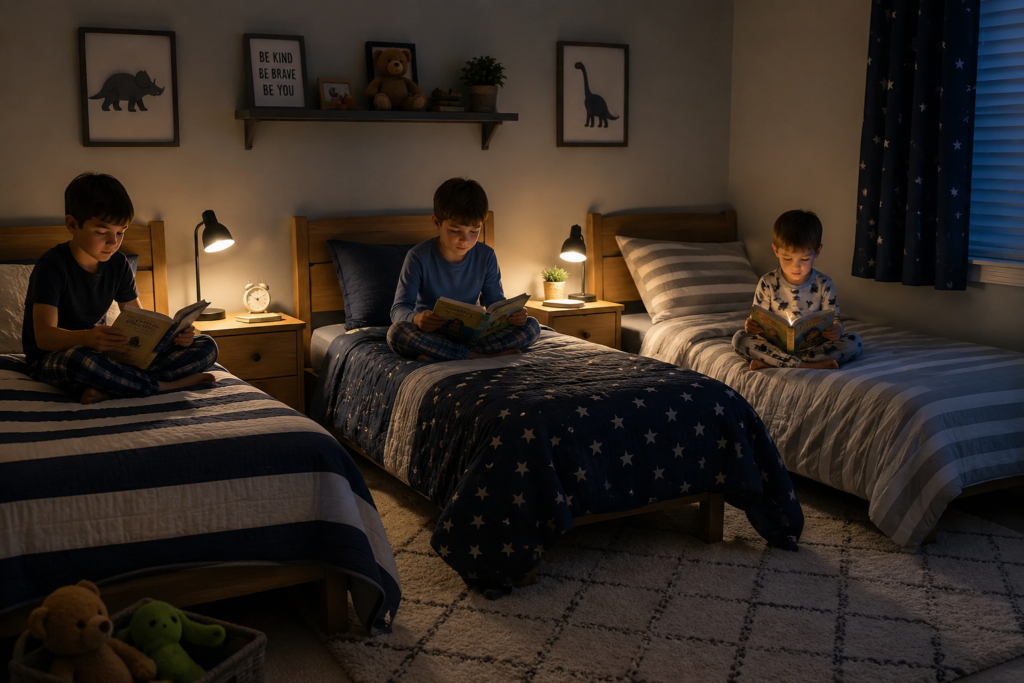
Right now my three older boys, ages 9, 7, and 4, all share one bedroom. They each have their own bed, but sharing a room means every bedtime challenge gets multiplied. If one child isn’t sleepy yet, he keeps everyone else awake. If one starts talking, the others immediately join in. Some nights it feels like they have been saving all of their energy just for the moment I say, “Goodnight.”
For a long time I thought I needed the perfect bedtime routine to fix everything. I imagined peaceful children quietly climbing into bed, whispering goodnight, and falling asleep within minutes.
That has never happened in my house.
Instead, I learned something much more realistic: bedtime doesn’t have to be perfect to be successful. It just needs to be predictable.
That simple mindset completely changed how I approached evenings. Rather than trying to stop every giggle or every whispered conversation, I focused on giving my boys the same routine every single night. Kids thrive on knowing what comes next, especially after a busy day full of school, playing, and endless energy.
One thing that has helped us even more is making bedtime start long before anyone actually gets into bed. By the time my boys walk into their shared bedroom, most of the exciting parts of the evening are already finished. They’ve had dinner, enjoyed their bath, brushed their teeth, and had time to slow their bodies down. That transition makes a huge difference.
If your evenings currently feel chaotic, I highly recommend reading my Best Bedtime Bath Routine for Kids because bath time has become the first signal that bedtime is approaching in our house. I also share exactly What to Do Between Bath Time and Bedtime to help avoid that wild burst of energy that often happens after baths.
Why Bedtime Is Harder When Brothers Share a Room
Sharing a bedroom has so many wonderful benefits. My boys always have someone to talk to, they build incredible memories together, and I know these years of sharing a room are something they’ll probably remember forever.
But let’s be honest, it also creates challenges that families with separate bedrooms don’t always deal with.
Instead of one child getting distracted, now there are three children feeding off each other’s energy.
One child rolls over…
The next one starts talking.
Someone giggles.
Then everyone is laughing.
Before you know it, the room has turned into a sleepover.
That’s completely normal.
Children naturally stimulate one another. Their excitement becomes contagious, especially between siblings who spend all day together. That doesn’t mean your bedtime routine is failing. It simply means your routine needs a little more structure than it would if everyone slept alone.
I’ve also noticed that each of my boys has a completely different personality at bedtime.
My oldest usually settles down fairly quickly once he has a book to read.
My seven-year-old loves chatting about his day and asks a hundred questions just when I’m ready to leave the room.
My four-year-old often wants “just one more hug,” another drink, or another trip to the bathroom.
Instead of expecting them all to behave exactly the same, I now build our bedtime routine around their differences while still keeping the same overall schedule.
Our Simple 8 PM Bedtime Routine
Our goal is lights out by 8:00 PM, especially during the school year.
Here’s what a typical evening looks like in our home:
- Dinner together
- Bath or shower
- Pajamas
- Brush teeth
- Quick bedroom tidy-up
- Fill water bottles
- Read together or quietly look at books
- Goodnight hugs
- White noise on
- Lights out at 8 PM
Does this happen perfectly every night?
Absolutely not.
There are nights when someone cries because he wanted the blue blanket instead of the green one. Someone suddenly remembers homework. The toddler wanders into the room. One child can’t find his favorite stuffed animal.
Life with four boys is wonderfully messy.
But because the overall routine stays the same every evening, we always find our way back without bedtime completely falling apart.
Products That Have Made Our Shared Bedroom Bedtime Easier
These are a few items that have genuinely helped reduce bedtime struggles.
(AD) Hatch Rest Sound Machine – Helps cover whispers, movement, and small noises that might otherwise keep siblings awake.
(AD) Soft Night Light for Kids – Gives enough light for bathroom trips without waking everyone.
(AD) Blackout Curtains – One of the easiest ways to help active boys fall asleep earlier during summer evenings.
(AD) Children’s Digital Alarm Clock with Night Mode – Older kids can easily see when it’s bedtime or morning without repeatedly asking.
You’ll also find all of my favorite bedtime products inside my Amazon storefront.
1. Start Calming Kids Before You Ever Walk Into the Bedroom
One of the biggest changes we made was realizing that bedtime doesn’t actually begin when the kids climb into bed, it begins at least an hour earlier.
For years, I expected my boys to go from running, laughing, wrestling, and making obstacle courses in the living room to suddenly lying quietly in bed. When that didn’t happen, I thought they were simply refusing to listen.
Now I understand that I was asking too much of them.
Kids, especially active boys, need time to transition. Their bodies don’t have an “off switch.” They need a gradual slowdown, just like adults do. Think about how hard it would be for you to fall asleep immediately after exercising or watching an exciting movie. Our children experience the same thing.
About an hour before bed, I start changing the atmosphere in our house. The TV goes off, loud toys are put away, and we choose quieter activities instead. Sometimes they’ll build LEGO together, work on a puzzle, color, or simply read books. I also lower the lights around the house, which naturally tells their brains that bedtime is getting closer.
I’ve found that this gentle transition reduces so much of the bedtime chaos before it even starts. They’re still children, they still laugh and play, but they’re no longer bouncing off the walls by the time they walk into their shared bedroom.
If you have boys who seem to get a “second wind” every evening, don’t skip this step. It has probably made the biggest difference in our home.
Before bedtime even begins, we often spend a little time doing one of these quiet time activities for active boys. It helps my boys burn off the last bit of excitement and makes the transition to bed much smoother.
2. Follow the Same Routine Every Single Night
Children don’t actually need endless reminders about what comes next. They need routines that become automatic.
Our bedtime routine is almost identical every evening because it removes the need for constant negotiating.
Nobody has to ask:
“Do I brush my teeth first?”
“Can I play one more game?”
“When do we read?”
Everyone already knows.
Children feel incredibly secure when life becomes predictable. Even if they complain occasionally, that consistency helps them relax because there are no surprises.
This doesn’t mean every evening has to happen at exactly the same minute. Life happens. Sometimes sports run late, sometimes dinner takes longer, sometimes we’re simply exhausted.
The order matters much more than the exact timing.
For example, our routine almost always looks like this:
- Bath or shower
- Pajamas
- Teeth
- Tidy bedroom
- Water bottles
- Story time
- Hugs
- Lights out
Because we’ve repeated it hundreds of times, my boys usually move from one step to the next without needing much direction.
That’s one less decision I have to make after a long day.
3. Give Each Child His Own Bedtime Job
One thing I’ve learned with multiple children is that kids are much less likely to create mischief when they have a small responsibility.
Instead of everyone wandering around the bedroom while I try to keep things moving, each child has his own simple bedtime job.
For example:
- My oldest checks that everyone’s water bottles are full.
- My second son makes sure books are back on the shelf and stuffed animals are on the beds.
- My four-year-old helps gather pajamas or places dirty clothes into the laundry basket.
These jobs only take a minute or two, but they give each child something purposeful to do instead of chasing one another around the room.
Children love feeling helpful, especially when they know their contribution matters.
It also teaches responsibility without making bedtime feel like another chore.
As your boys grow older, you can easily adjust these jobs to match their ages. Older children can straighten blankets or close curtains while younger siblings handle smaller tasks.
4. Expect Some Talking, Just Set Boundaries
This is something I had to accept for my own sanity.
Brothers who share a room are probably going to talk.
Honestly, I don’t even mind a few minutes of whispering anymore.
They’re making memories.
They’re sharing stories from their day.
Sometimes they’re laughing about something that happened hours earlier.
Those little conversations are actually one of the sweetest parts of sharing a bedroom.
The problem starts when whispering turns into wrestling.
Or someone jumps out of bed.
Or voices become louder instead of quieter.
Instead of demanding complete silence, we’ve made one simple rule:
You may quietly whisper while lying in your own bed, but your body stays in bed.
That single rule is much easier for children to understand than expecting complete silence the second the lights go off.
Most nights, the whispers naturally fade after a few minutes because they’re already relaxed enough to fall asleep.
When I stopped trying to eliminate every sound, bedtime became much less stressful for everyone, including me.
5. Keep the Bedroom Calm and Boring
This might sound funny, but I don’t actually want my boys’ bedroom to be the most exciting room in the house.
Their bedroom should tell their brains one thing:
This is where we sleep.
That means we avoid loud toys before bed, flashing lights, exciting games, and roughhousing once pajamas are on.
We also try to keep the room reasonably tidy because I’ve noticed clutter makes bedtime feel more chaotic. Toys scattered across the floor seem to invite one last game before bed.
A quick two-minute cleanup every evening helps create a calmer environment and makes the room feel much more peaceful.
You don’t need a picture-perfect bedroom.
Trust me, ours certainly isn’t.
But a clean pathway to each bed, a dim light, cozy blankets, and a peaceful atmosphere can make it much easier for everyone to settle down.
Helpful Products for Shared Bedrooms
These are a few more products worth recommending naturally throughout the post:
- (AD) Bedside Caddy for books, flashlights, and water bottles.
- (AD) Laundry Hamper to encourage quick evening cleanup.
- (AD) Kids’ Bookshelf to keep bedtime books organized.
- (AD) Soft Glow Night Light that won’t disturb sleeping siblings.
6. Handle Bedtime Interruptions Without Starting Over
If you’ve ever tucked your kids into bed only to hear someone yell, “Mom!” thirty seconds later, you’re definitely not alone.
In our house, bedtime interruptions used to feel endless.
Someone needed another drink of water.
Someone had to use the bathroom again.
Someone couldn’t find his favorite stuffed animal.
Someone suddenly remembered an incredibly important story that absolutely couldn’t wait until morning.
And of course, once one child got out of bed, the others usually followed.
I eventually realized that every time I restarted the entire bedtime routine, I was accidentally teaching my boys that getting out of bed led to more attention and a longer bedtime.
Now I try to keep my responses calm, short, and predictable.
If someone genuinely needs something, I help them quickly without turning it into a conversation. Then it’s simply, “Goodnight, I love you. Back to bed.”
No lectures.
No negotiating.
No frustration.
The calmer I stay, the faster they settle again.
Some nights I repeat that phrase several times, and that’s okay. Children learn through repetition, not because we explain something perfectly once.
One thing I’ve learned after raising four boys is that consistency almost always works better than intensity. Staying calm night after night eventually pays off, even when it doesn’t feel like it in the moment.
7. Help Each Child Wind Down in His Own Way
Even though my boys share a bedroom, I’ve stopped expecting them to relax in exactly the same way.
My oldest often likes a few quiet minutes with a book before turning off his bedside light.
My second son usually wants to tell me one last funny story about his day before he settles down.
My four-year-old still loves an extra cuddle and needs a little reassurance before I leave the room.
Years ago, I thought everyone needed the exact same bedtime routine. Now I know that while the overall structure stays the same, the last few minutes can look a little different for each child.
Some children need quiet.
Some need connection.
Some simply need to know you’ll check on them again in a few minutes.
When we meet those individual needs within the same routine, bedtime often becomes much smoother.
8. Don’t Expect Every Night to Be Perfect
This might be the most important thing I can share.
Some evenings are just hard.
There are days when my boys have too much energy, days when they’re overtired, days when someone is emotional because school was difficult, or days when everyone seems determined to make bedtime last forever.
I’ve had nights where I walked back into that bedroom more times than I could count.
I’ve also had nights where they were asleep within fifteen minutes and I wondered why I ever worried.
That’s motherhood.
Progress isn’t measured by one peaceful evening.
It’s measured by weeks and months of consistently showing up.
Children are learning.
They’re growing.
They’re figuring out how to manage their emotions, their excitement, and their independence.
Our job isn’t to create perfect children. It’s to give them routines they can rely on while they learn those skills.
If bedtime feels messy right now, don’t assume you’re doing something wrong.
It might simply mean you’re raising healthy, energetic kids who need a little more time to learn.
And one day, just like my older boys eventually started enjoying bath time after years of resisting it, your bedtime struggles will probably look very different too.
Our Favorite Bedtime Products
These are a few products that have genuinely made our evenings easier.
(AD) Hatch Rest Sound Machine – Helps block out whispers, hallway noises, and the little sounds siblings make while settling into sleep.
(AD) Blackout Curtains – Especially helpful during the summer when it’s still bright outside at bedtime.
(AD) Bedside Caddy Organizer – Keeps books, water bottles, and comfort items within easy reach so kids don’t need to get out of bed.
(AD) Kids’ Digital Alarm Clock – Gives older children a clear visual cue for bedtime and wake-up time.
(AD) Cozy Weighted Stuffed Animal or Bedtime Plush – Many children enjoy hugging something comforting while falling asleep.
You’ll find all of my favorite bedtime products and family essentials in my Amazon Storefront.
More Bedtime and Routine Posts You’ll Love
If bedtime is one of the hardest parts of your day, these posts can help you build an evening routine that feels much calmer:
- Best Bedtime Bath Routine for Kids
- How to Make Bath Time Fun (Even If Your Kids Usually Hate It)
- What to Do Between Bath Time and Bedtime
- Products That Make Bedtime Easier for Overstimulated Kids
- Summer Screen Time Rules for Kids
- Quiet Time Activities for Active Boys
- How to Keep Brothers From Fighting All Summer Long
Don’t Leave Without Your Free Printable!
Before you go, grab your Free Brothers’ Bedtime Routine Chart.
It’s designed for brothers ages 4–10 who share a room and gives them a simple visual checklist they can follow every evening. Instead of answering the same bedtime questions over and over, you can simply point to the chart and let the routine guide them.
Print it, laminate it if you’d like, and use a dry-erase marker so your boys can check off each step every night. It’s a small change, but it can help bedtime feel much more predictable, and a little more peaceful for everyone.
Final Thoughts
Sharing a bedroom isn’t always easy, especially when your kids are close in age and full of energy. There are evenings when you’ll hear giggles long after lights out, nights when someone gets out of bed for the fifth time, and moments when you’ll wonder if anyone is ever going to fall asleep.
But there will also be whispered conversations you’ll smile about from the hallway, bedtime stories shared between brothers, and a friendship that’s growing because they get to end every day together.
That’s what I remind myself on the hard nights.
The goal isn’t to raise children who never make a sound after bedtime.
The goal is to create a home where they feel safe, loved, and secure enough to rest.
And if bedtime is still a little messy sometimes?
Welcome to life with brothers.
Frequently Asked Questions About Brothers Sharing a Bedroom
Is it okay for brothers of different ages to share a room?
Yes, in many families it works very well, especially when the children have compatible bedtimes and enough personal space. My boys are 9, 7, and 4, and while bedtime can certainly be noisy sometimes, sharing a room has also helped them build a close relationship. They learn to respect each other’s space, solve small disagreements, and enjoy having built-in bedtime companions.
As they get older, you may eventually decide they need separate rooms, but for many families, brothers sharing a bedroom throughout elementary school works beautifully.
How do I stop my kids from talking after lights out?
Honestly, I don’t try to stop every whisper anymore.
A few quiet minutes of talking is completely normal, especially for siblings who have spent the entire day together.
Instead, I focus on keeping them in their own beds and speaking quietly. Most nights the conversation naturally fades as they become sleepier. If they become loud or start getting out of bed, I calmly remind them of the bedtime rules without turning it into a long discussion.
Trying to force complete silence often creates a power struggle that keeps everyone awake even longer.
What if one brother falls asleep much earlier than the others?
If one child naturally gets tired earlier, try giving him the quietest bed in the room, usually the one farthest from the bedroom door or away from the main walking path.
A white noise machine can also help block small sounds while the other children are settling down.
You can even allow older siblings to quietly look at books in bed for a few minutes while younger children fall asleep first.
Should siblings have the same bedtime?
Not necessarily.
Children have different sleep needs depending on their age. However, if your children are relatively close in age, like mine, having one shared bedtime routine usually makes evenings much easier.
Even if one child falls asleep faster than the others, following the same routine together helps prevent jealousy and keeps the evening predictable.
How do I keep brothers from waking each other up?
A few simple changes can make a surprising difference:
- Use a white noise machine.
- Keep a dim night light for bathroom trips.
- Encourage children to prepare water bottles before bed.
- Keep favorite comfort items within reach.
- Make sure everyone uses the bathroom before lights out.
- Teach children to whisper instead of calling across the room.
These little habits reduce many of the common reasons kids wake one another during the night.
My Biggest Bedtime Lesson After Raising Four Boys
If there’s one thing motherhood has taught me, it’s that routines don’t have to be perfect to work.
For a long time, I believed I was doing something wrong because bedtime never looked peaceful. I would compare our evenings to the picture-perfect routines I saw online, where children climbed into bed smiling and fell asleep within minutes.
That wasn’t our reality.
Our reality looked more like one boy hopping out of bed to show me a toy, another trying to make his brothers laugh, and my youngest asking for one more hug before I closed the door.
And honestly?
That’s okay.
Little by little, our evenings became calmer, not because my boys suddenly changed overnight, but because we stayed consistent. We kept following the same routine, we stayed patient (most of the time!), and we focused on progress instead of perfection.
Now, even on our chaotic nights, bedtime feels much less overwhelming because everyone knows what to expect.
If you’re in the middle of bedtime battles right now, I hope this encourages you.
Keep showing up.
Keep following your routine.
Keep giving yourself grace on the hard nights.
One day you’ll realize bedtime has quietly become easier, and you’ll wonder when it happened.
Save This Post for Later
If you’re not quite ready to create your new bedtime routine tonight, save this post on Pinterest so you can come back to it whenever you need a fresh start.
And if you know another mom whose boys turn bedtime into a nightly sleepover, share this post with her. Sometimes just knowing another family is going through the same thing makes those long evenings feel a little lighter.
Related Posts You’ll Love
Continue building calm evenings with these helpful guides:
- Best Bedtime Bath Routine for Kids
- How to Make Bath Time Fun and Relaxing for Kids
- What to Do Between Bath Time and Bedtime
- Products That Make Bedtime Easier for Overstimulated Kids
- After-School Routine for Kids
- Homework Routine for Kids Who Hate Homework
- Quiet Time Activities for Active Boys
- Summer Screen Time Rules for Kids
- How to Keep Brothers From Fighting All Summer Long
Such helpful tips! Thanks so much for sharing.
Thank you so much, Pamela! 💛 I’m so glad you found the tips helpful. I really appreciate you stopping by, and I hope they help make bedtime a little easier for your family too! 😊
So true, having a routine is a total lifesaver for smoother, calmer bedtimes 😅💛
Thank you, Giangi! 😊 I completely agree. Once we found a routine that worked for our boys, bedtime became so much calmer and less stressful for everyone. Thanks so much for taking the time to comment! 💛