Homework Routine for Kids Who Hate Homework
As an Amazon Associate, I earn a small commission from qualifying purchases.
If you’re looking for a homework routine for kids who hate homework, you’re definitely not alone. In our house, homework can sometimes feel harder than the homework itself. Between my 9-year-old who would rather be building LEGO creations and my 7-year-old who suddenly needs a snack, a drink, a bathroom break, and possibly a full life discussion before opening his workbook, I’ve learned that getting homework done isn’t about forcing kids to sit longer. It’s about creating a routine that removes the daily battle.
One item that has made a surprising difference in our homework space is a simple desk organizer. (AD) Shop on Amazon: Desk Organizer Set
The good news? Most kids don’t actually hate learning. They hate stress, interruptions, feeling overwhelmed, and being pulled away from things they’d rather be doing. A good homework routine helps solve all of those problems.
Why Some Kids Hate Homework
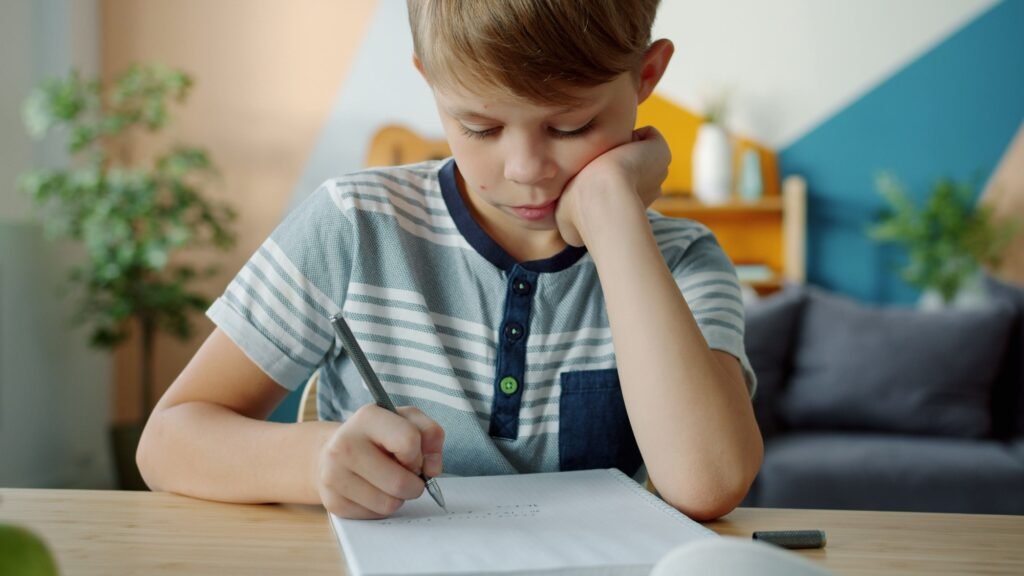
Before creating a homework routine, it helps to understand why homework becomes a struggle.
Many elementary-age kids spend 6–8 hours at school following directions all day. By the time they get home, they’re mentally tired.
Add in:
- Hunger
- Sibling distractions
- Sports and activities
- Long school days
- Difficult assignments
- Perfectionism
- Lack of motivation
And suddenly a 15-minute worksheet turns into a 90-minute battle.
I noticed this especially with my older boys. The moment they walked through the door, the last thing they wanted was more schoolwork. What they actually needed first was a chance to recharge.
That’s why our routine starts with a break, not homework.
The Homework Mistake Most Parents Make
Many parents ( me included) understandably want homework finished immediately.
The problem?
Kids often need a transition period between school and homework.
Imagine walking into your house after a long workday and someone immediately handing you another project to complete before you can sit down.
That’s exactly how homework feels for many kids.
Instead of starting homework the second they get home, try:
Step 1: Snack Time
A hungry child is rarely a cooperative child.
Keep simple snacks ready:
- Cheese sticks
- Crackers
- Apple slices
- Yogurt
- Granola bars
- Fruit
This gives kids a chance to refuel while also mentally switching from “school mode” to “home mode.”
Step 2: Movement Break
This is especially important for active boys.
After sitting most of the day, kids often need to move before they can focus.
Ideas include:
- Jumping on a trampoline
- Riding bikes
- Playing outside
- Shooting basketballs
- Dancing
- Walking the dog
Even 20–30 minutes of movement can dramatically improve focus later.
Step 3: Homework Time
Once they’ve eaten and moved their bodies, they’re usually much more willing to sit down and work.
Create a Dedicated Homework Space
One of the biggest improvements we made was giving homework a predictable location.
Kids focus better when they know exactly where homework happens.
Your homework space doesn’t need to be fancy.
A kitchen table works perfectly.
The goal is simply to have:
- Good lighting
- Pencils nearby
- Erasers
- Crayons
- Chargers if needed
- Minimal distractions
(AD) Shop on Amazon: Homework Supply Caddy
Keep Supplies Within Reach
Nothing destroys momentum faster than:
“Mom, where’s my pencil?”
Two minutes later:
“Mom, I need scissors.”
Then:
“Mom, I lost my eraser.”
I always keep supplies together to eliminates these interruptions.
Use the “Easy First” Strategy
One trick that works surprisingly well is letting kids start with their easiest assignment.
Why?
Because success builds momentum.
When kids finish something quickly, they feel capable.
Instead of staring at a long math worksheet and feeling overwhelmed, they experience an immediate win.
Try this order:
- Easiest assignment
- Medium assignment
- Hardest assignment
- Reading
Many children become far more cooperative when they see progress right away.
Related posts:
- After-School Routine for Elementary Boys
- Back-to-School Checklist for Moms
- Homework Station Ideas for Small Spaces (future post)
- How to Be an Organized Mom When Life Feels Chaotic
The 10-Minute Homework Start Trick
One of the biggest lessons I’ve learned with my boys is that getting started is usually the hardest part.
Most kids imagine homework will take forever. They build it up in their minds until it feels much bigger than it actually is.
Instead of saying:
“You need to finish all your homework.”
Try saying:
“Let’s just work for 10 minutes.”
Ten minutes feels manageable.
Almost every time, once my boys get started, they keep going. The resistance was never really about the homework itself. It was about starting.
This works because you’re lowering the mental barrier.
For younger elementary kids, you can even set a visual timer.
(AD) Shop on Amazon: Visual Countdown Timer
Kids often work better when they can see how much time is left.
How to Handle Homework Complaining Without Starting an Argument
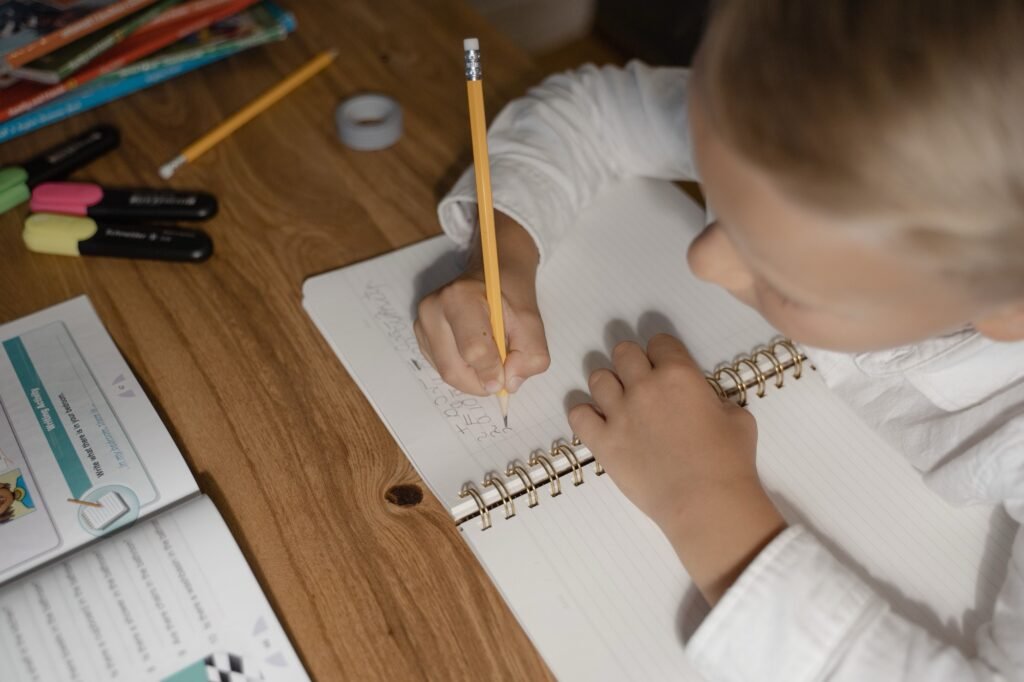
If your kids are anything like mine, you’ve probably heard:
- “This is too hard.”
- “I hate homework.”
- “Why do I have to do this?”
- “Can I do it later?”
- “It’s not even important.”
It’s tempting to argue back.
Unfortunately, that usually creates an even bigger battle.
Instead, stay calm and acknowledge their feelings without changing the expectation.
For example you can say:
“I know you don’t feel like doing it today.”
“I understand it’s frustrating.”
“It’s okay to dislike homework.”
Then calmly follow with:
“Homework still needs to be finished.”
This approach avoids power struggles while keeping boundaries clear.
The goal isn’t convincing them to love homework.
The goal is teaching them that sometimes we do things we don’t feel like doing.
That’s a valuable life skill.
Break Big Assignments Into Smaller Pieces
A worksheet filled with twenty problems can feel overwhelming.
But five problems?
Most kids can handle five problems.
When homework seems too big, break it down.
For example:
- Complete 5 questions.
- Take a 2-minute stretch break.
- Complete 5 more.
- Get a drink.
- Finish the next section.
Small wins help kids build confidence and reduce frustration.
This strategy is especially helpful for perfectionists who freeze when an assignment looks difficult.
Create a Homework Rewards System That Encourages Consistency
I’m not a huge fan of paying kids for every piece of homework.
Homework is part of their responsibility.
However, I do love rewarding consistency and effort.
Instead of rewarding grades, reward habits.
For example:
Homework Points System
Each day a child:
- Starts homework without arguing = 1 point
- Finishes homework = 1 point
- Stays focused = 1 point
Points can be traded for:
- Extra reading time
- Choosing dessert
- Family game night choice
- Staying up 15 minutes later on Friday
- Picking a weekend activity
This keeps the focus on behavior rather than perfection.
Don’t Correct Every Mistake
This one can be difficult.
When we see mistakes, our instinct is often to jump in immediately.
But constantly correcting kids can make homework feel even more frustrating.
Instead:
- Let them try first.
- Praise effort.
- Offer help when requested.
- Guide rather than rescue.
Homework should help teachers see what children actually understand.
It’s okay if every answer isn’t perfect.
Confidence matters too.
Make Reading Part of the Routine
Reading often feels less stressful than worksheets, making it a great way to end homework time.
For my oldest son, reading has become the reward at the end of the routine.
After assignments are finished, he gets to spend time with a book he enjoys.
Some popular choices for elementary boys include:
- Diary of a Wimpy Kid
- Dog Man
- The Last Kids on Earth
- Wayside School
- InvestiGators
(AD) Shop on Amazon: Complete Diary of a Wimpy Kid Collection
When kids associate homework time with eventually reaching something enjoyable, resistance often decreases.
How to Manage Siblings During Homework Time
If you only had one child doing homework, this entire process would probably be much easier.
But when you have multiple kids, especially energetic brothers, homework time can quickly turn into chaos.
This is one of the biggest challenges in our house.
One child needs help with math.
Another wants a snack.
The preschooler suddenly wants attention.
The toddler decides now is the perfect time to climb onto the table.
Over time, I’ve learned that the goal isn’t creating perfect silence. The goal is reducing interruptions enough for homework to get done.
Here are a few things that help:
Give Younger Siblings Their Own “Work”
Little brothers love copying big brothers.
Create a special activity basket filled with:
- Coloring books
- Stickers
- Puzzles
- LEGO
- Water Wow books
- Magnetic tiles
When younger children have their own “important work,” they’re less likely to interrupt.
(AD) Shop on Amazon: Water Wow Activity Books
(AD) Shop on Amazon: Magnetic Tiles Set
Rotate Independent Activities
Keep a few special activities that only come out during homework time.
Because they’re not available all day, they stay exciting longer.
Use Separate Spaces When Possible
Your children don’t need individual offices.
They simply need enough space to focus.
Sometimes one child works at the kitchen table while another works nearby at a desk.
A little distance often prevents a lot of arguing.
What to Do When Homework Takes Forever
Many parents assume their child needs more discipline when homework drags on for hours.
Sometimes that’s true.
But often the real problem is distraction.
Watch how much time is actually spent working.
A 20-minute assignment can easily become a 90-minute assignment when kids spend most of that time:
- Daydreaming
- Talking
- Playing with pencils
- Looking around the room
- Getting snacks every five minutes
Instead of focusing on finishing quickly, focus on working consistently.
Try using:
Work-Break Cycles
For younger elementary kids:
- 15 minutes work
- 3–5 minute break
For older elementary kids:
- 20–25 minutes work
- 5 minute break
This gives kids a clear finish line and helps prevent burnout.
Common Homework Mistakes Parents Make
I’ve made most of these myself.
Mistake #1: Starting Homework Too Soon
Kids need time to decompress after school.
A snack and movement break often make homework much easier.
Mistake #2: Turning Homework Into a Daily Battle
When homework becomes a power struggle, everyone loses.
Stay calm, stay consistent, and keep expectations simple.
Mistake #3: Expecting Perfect Focus
Elementary-age kids aren’t designed to focus for long periods.
Short breaks are normal and healthy.
Mistake #4: Helping Too Much
It’s hard watching children struggle.
But doing the work for them prevents independence.
Guide them. Don’t rescue them.
Mistake #5: Being Inconsistent
The most effective homework routine isn’t the fanciest one.
It’s the one you repeat every day.
Kids thrive on predictability.
When they know what happens after school, homework becomes part of the routine instead of a daily surprise.
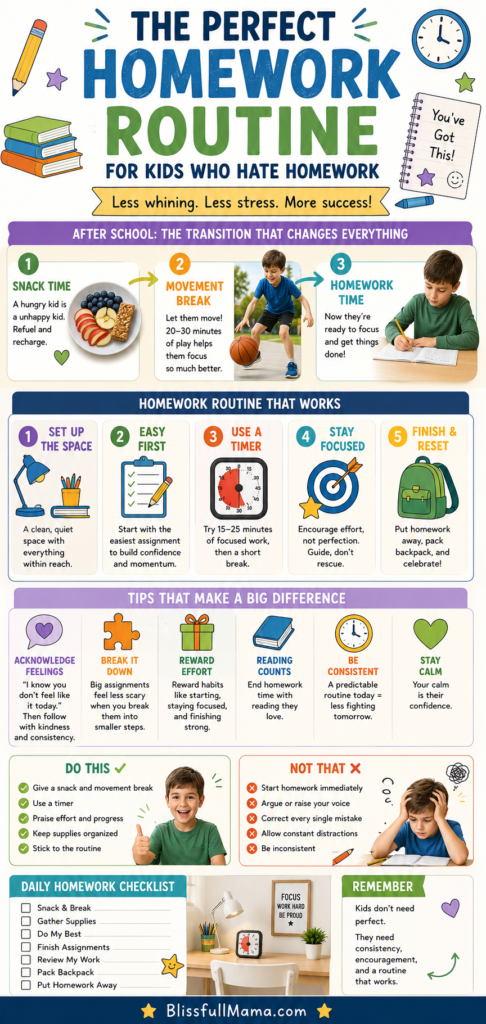
A Simple Homework Routine for Kids Who Hate Homework
If you only take one thing from this post, let it be this:
Keep it simple.
Here’s the basic routine that works best in our house:
After School
✔ Snack
✔ 20–30 minutes of outdoor play or movement
Homework Time
✔ Gather supplies
✔ Start with easiest assignment
✔ Use a timer
✔ Take short breaks when needed
✔ Ask for help when stuck
When Homework Is Finished
✔ Read for 15–20 minutes
✔ Pack backpack
✔ Put papers away
✔ Enjoy free time
The routine itself isn’t magical.
The consistency is.
The more often kids follow the same steps, the less energy they spend arguing about homework.
Final Thoughts
If your child hates homework, it doesn’t mean they’re lazy.
It doesn’t mean you’re failing.
And it definitely doesn’t mean homework time has to end in tears every day.
Most kids do better when they know what to expect, have a chance to recharge after school, and work through assignments in manageable chunks.
As a mom of four boys, I’ve learned that routines solve many problems that discipline alone can’t.
A simple homework routine won’t make kids love homework overnight.
But it can make afternoons calmer, reduce arguments, and help everyone end the day in a much better mood.
And honestly, that’s a win in my book.
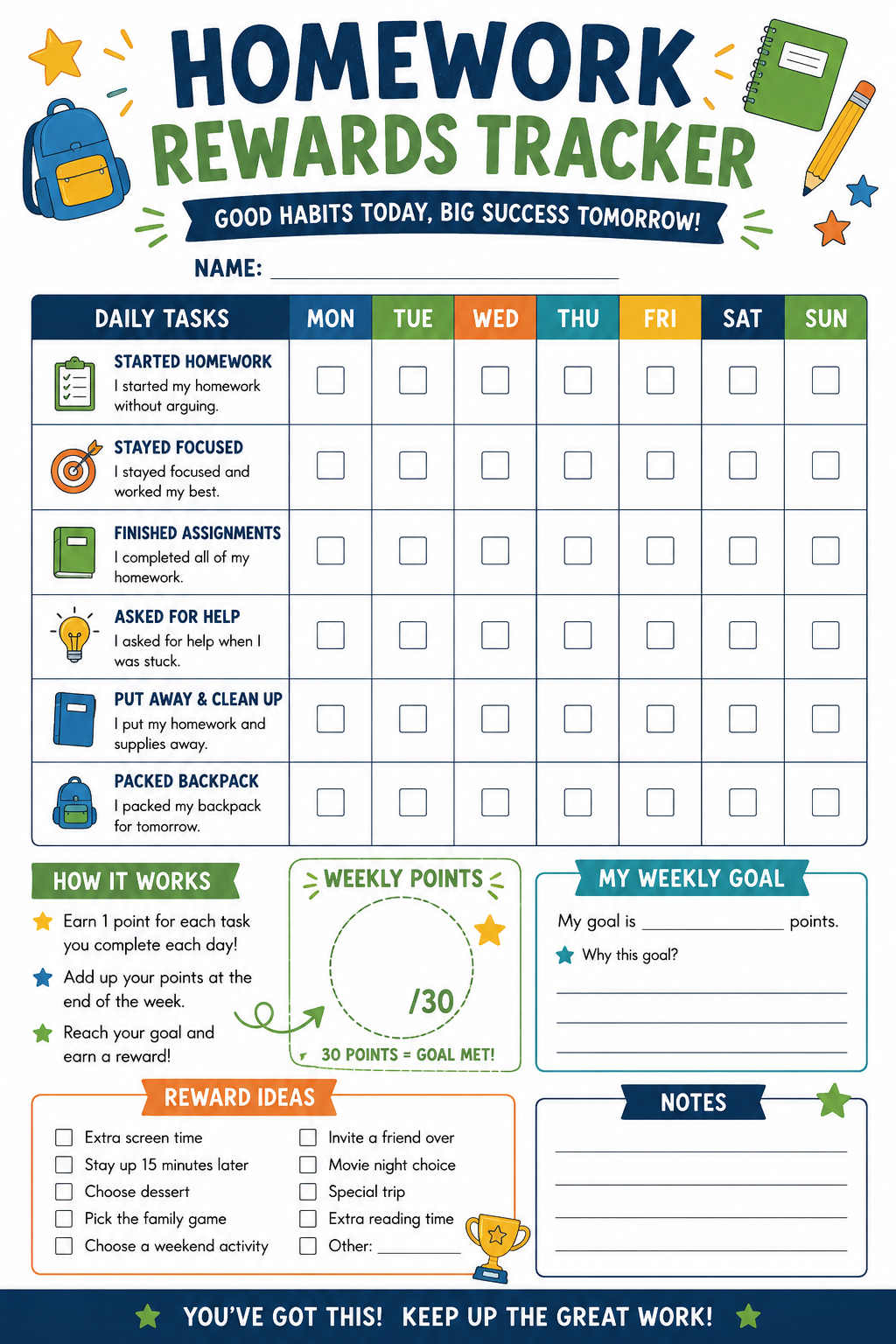
Grab Your Free Homework Rewards Tracker
Want to make homework time easier?
Download the Homework Rewards Tracker and help your kids build consistent homework habits without daily battles.
The printable includes:
✔ Daily homework checklist
✔ Weekly points tracker
✔ Reward ideas for elementary-age kids
✔ Space for personal goals
✔ Simple, kid-friendly design
Get your free Homework Rewards Tracker below and start building a homework routine that actually works.