
Toy Decluttering Before Christmas: Keep, Donate or Rotate
Toy decluttering before Christmas can feel surprisingly difficult when your children want to keep everything, and part of you understands why.
I have four boys, so deciding what stays is rarely as simple as asking whether someone still plays with it. There is also the younger-sibling question. What if his little brother wants it next? What if we give it away and need it again?
Meanwhile, we still have the same amount of storage.
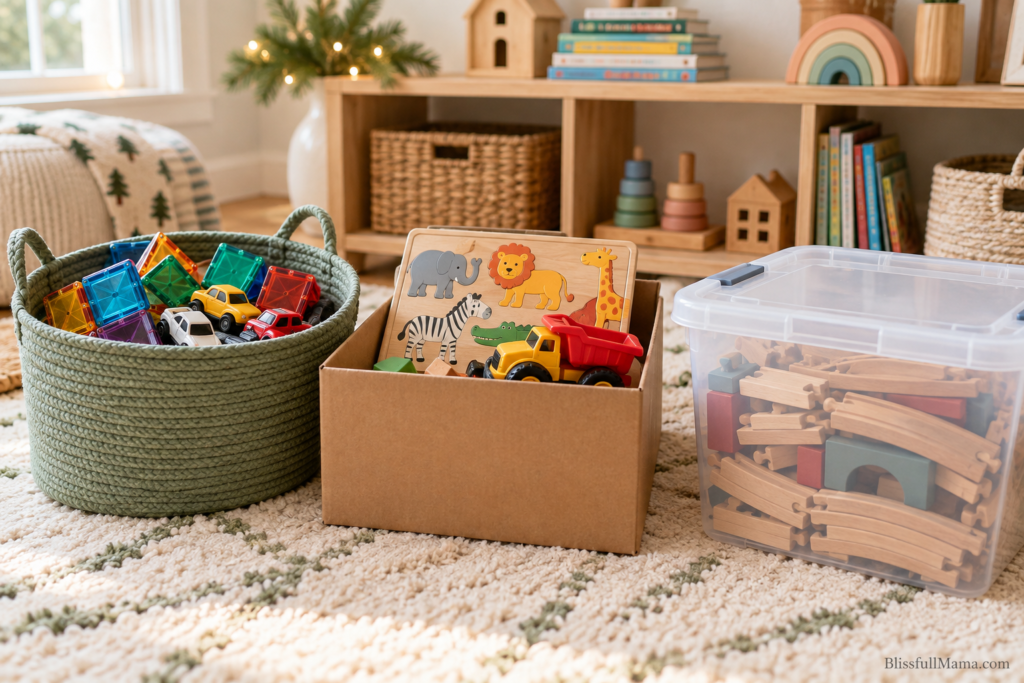
Building toys, magnetic tiles, cars, trucks, and tracks are the things my boys consistently return to. Those are the easy decisions. It is everything around them that gets complicated: toys that occasionally get attention, things someone might grow into, and the mixed bins that make it hard to see what we actually have.
We do rotate toys, but I cannot pretend everything stays neatly separated. Sometimes the toys that should be taking a break end up mixed back in with the everyday favorites.
If that sounds familiar, this is a manageable place to begin. You do not need to empty the whole playroom or convince your children to part with half their belongings. You need a way to decide what belongs out now, what is worth storing, and what your family is ready to pass along.
As an Amazon Associate, I earn from qualifying purchases.
Too Many Toys? Start With One Basket.
Get the free Keep, Donate or Rotate printable, with a simple sorting checklist, space to record toys saved for younger siblings, and a donation plan you can actually finish.
Start With One Toy Category, Not the Whole Playroom
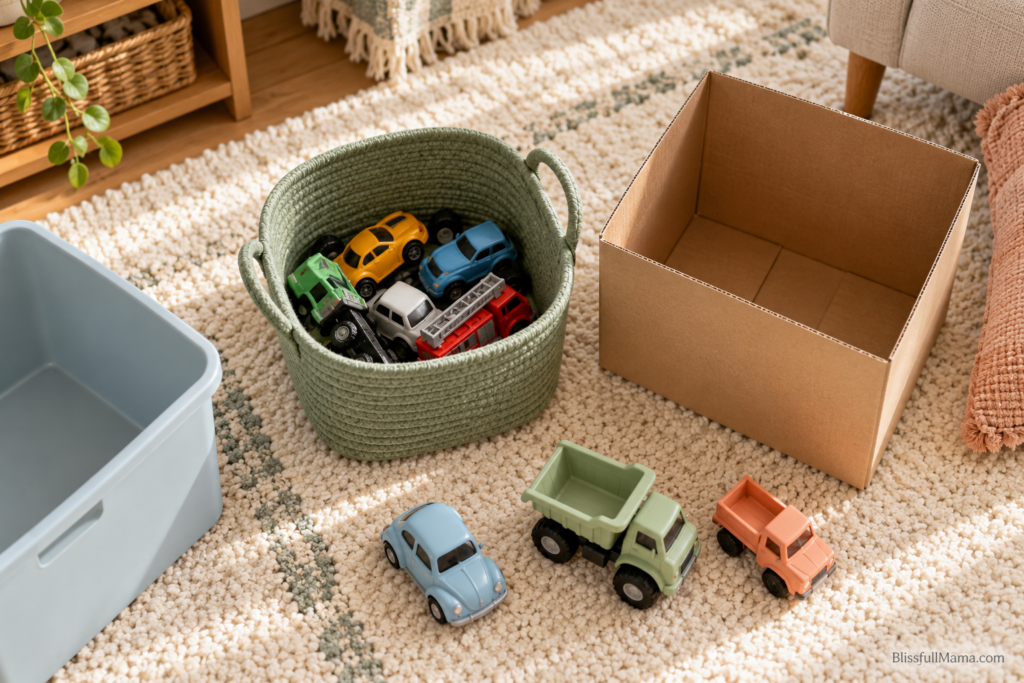
Please do not pull every toy onto the floor if you only have fifteen minutes.
That approach leaves you with a bigger job right when someone needs a snack, the toddler needs you, or it is time to leave for school pickup.
Choose one small category instead:
- The basket of toy cars.
- One shelf of puzzles.
- The tub of baby toys.
- One container of pretend-play accessories.
- The toys gathered in the living room.
Pick a category small enough that you can put everything away before you stop.
Gather three existing baskets, boxes, or bags and label them keep, donate, and rotate. Set aside damaged items separately so they do not get mixed into donations.
You do not need matching containers to make these decisions. A cardboard box and a handwritten label are enough.
If the toy mess is part of a bigger household buildup, my fall decluttering checklist gives you other small categories to tackle after this one. For now, stay with the toys you chose.
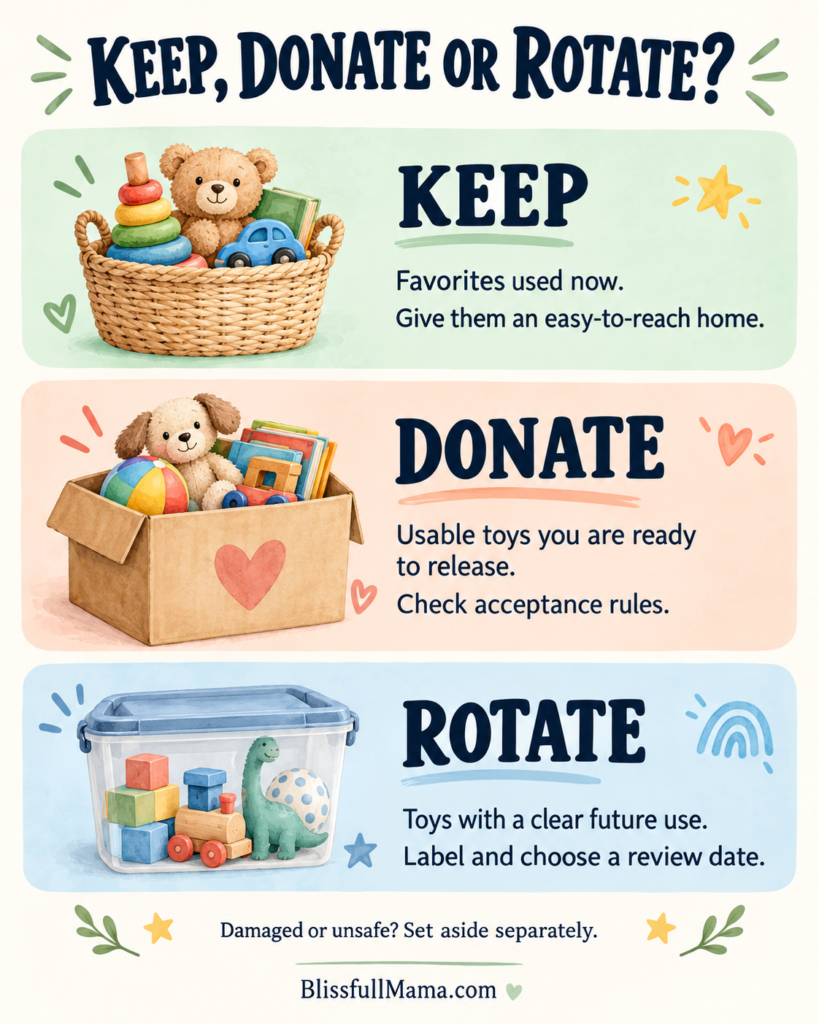
The Keep, Donate or Rotate Decision Guide
The most useful question is not “Could someone possibly play with this again?”
With children, the answer can be yes to almost anything.
Ask instead: “Does this toy have a clear place in our family’s life now, or a specific reason to stay for later?”
| Decision | What belongs here | What happens next |
| Keep out | Current favorites, comfort items, and toys used in meaningful play | Give them an accessible home |
| Donate | Usable toys your family is ready to release | Check the recipient’s requirements and arrange the handoff |
| Rotate or save | Toys with a clear future use that you have room to store | Label the contents, reason, and review date |
A broken or unsafe toy needs a separate decision. It does not become a donation simply because you no longer want it.
Keep: The Toys That Earn Their Everyday Space
Start by choosing what stays. It is easier to work out what is extra when the favorites are already clear.
In our home, building toys, magnetic tiles, cars, trucks, and tracks belong in this conversation first. My boys return to them, which tells me more than whether a toy looks tidy on a shelf.
Look for toys your children:
- Choose without you suggesting them.
- Use in several different ways.
- Return to across different days.
- Enjoy together, where appropriate for their ages.
- Treasure for comfort or personal meaning.
A favorite does not have to be educational, expensive, wooden, or attractive. It just needs to matter to the child using it.
You also do not need to remove duplicates automatically. Several cars may be part of a race. Extra building pieces may make it possible for siblings to build at the same time. Look at how the toys are used before deciding there are “too many.”
Give the keep pile a realistic boundary. Can the cars fit in their basket without being forced in? Can your child reach the building pieces and put them away?
If not, try dividing that category between everyday access and rotation before buying another organizer.
Keep age-inappropriate small pieces out of younger siblings’ reach, even when they belong to an older child’s favorite set.
Donate: The Toys Your Family Is Ready to Pass Along
The donation pile is for usable toys that no longer need a place in your home.
Good candidates might include a playset everyone has outgrown, an activity nobody enjoys, or a duplicate that adds nothing to their play.
Before adding something, ask:
Does anyone in our family still want and use this? Include the younger children in that decision, rather than judging only by the oldest child.
Is it ready for another child to use? Check its condition and whether the pieces needed to play are included.
Am I keeping it mainly because of what it cost? That feeling is understandable. But keeping an unused toy does not recover the money.
A toy can have been a worthwhile purchase for an earlier stage without needing to stay forever.
Check what your chosen organization or recipient accepts before packing everything up. Do not assume a holiday toy drive accepts used toys; confirm its rules first.
Keep sets together, clean items as appropriate, and choose a realistic handoff date. Otherwise, the donation bag can become another object you work around.
Rotate: Toys Worth Keeping, Without Keeping Everything Out
Rotation is useful when a toy still has a role but does not need to be available every day.
It might be a puzzle that feels fresh after a break, a pretend-play set that competes for floor space, or an activity you want to bring out occasionally.
But rotation can also become a place to put every difficult decision.
Before storing something, finish this sentence:
“I am keeping this because…”
A useful answer is specific: “He still enjoys this, but we only have space for one track set out at a time.”
“I feel bad getting rid of it” tells you the decision needs more thought. It does not automatically mean the toy belongs in rotation.
Label the container with what is inside and a review date that fits your schedule. Keep rotation toys separate from everyday toys so you are not repeatedly sorting the same mixed pile.
You could set aside a small selection for quiet-time activities, too, if that gives the toys a practical purpose in your day.
What About Toys You’re Saving for a Younger Sibling?
This is the part I find especially easy to get stuck on.
With four boys, there is often someone younger who might enjoy a toy later. That is a real reason to save something, but it can also make almost everything feel worth keeping.
Separate saving for a sibling from ordinary rotation.
Rotation means a child could enjoy the toy now. Sibling storage means you are keeping it for a later stage.
For each toy you save, ask:
- Which child am I saving it for?
- Is it suitable for that child’s age and abilities, or clearly labeled for later?
- Do we already have something that serves the same purpose?
- Is it complete and in good condition?
- Where will it live until we need it?
Choose a storage limit that fits your home, such as one labeled container for the next stage. This is a household boundary, not a rule about how many toys a child should have.
When the container fills up, compare what is inside before starting another one. Keep the toys you have the clearest reason to use again.
You can browse my (AD) Amazon storefront for family and home finds, but sort first. You will make a more useful storage purchase once you know exactly what needs a home.
For today, one finished basket counts: favorites back where they belong, rotation toys labeled, and donations ready for their next step.
That is enough of a starting point.
What to Say When Your Kids Want to Keep Everything
My boys wanting to keep everything is one of the hardest parts of sorting toys. I can see an overflowing basket; they can see something they might still want.
If your children feel the same way, begin with a smaller question than “What can we get rid of?”
Try:
“Show me the toys you definitely want to keep playing with.”
Let them choose those first. Then work through a few remaining toys together.
For a toy they are unsure about:
“Would you like this on your shelf now, or in the rotation box for later?”
When the basket is full:
“These need to fit so you can find them and put them away. Which ones should stay out?”
When they are ready to donate:
“You’ve finished playing with this, and it’s still in good condition. Shall we find someone who would like it?”
Keep donation an honest, specific conversation. Avoid making children feel guilty about having toys, or suggesting they must give things away to deserve Christmas presents.
And if you agree that a toy is going into rotation, keep that promise. Do not secretly turn the rotation box into a donation bag.
A short pause is fine when someone gets upset. Move to a less emotional category and return to that decision another day.
A Realistic Toy Decluttering Plan for Busy Moms
You can do your toy decluttering before Christmas in short sessions spread across a week. Choose just one overflowing category for this first round.
| Session | Your small job | Stop when… |
| 1: Gather | Bring together that category and separate obvious rubbish or damaged items | You can see what you are sorting |
| 2: Choose favorites | Help the children select what stays out | The everyday selection fits its space |
| 3: Decide the rest | Sort donations, rotation toys, and younger-sibling storage | Each item has a clear destination |
| 4: Finish | Label stored toys, put favorites away, and arrange donations | Nothing is left in an unexplained pile |
Aim for ten to fifteen minutes at a time, adjusting the size of the category to fit your available time. A large toy collection will need more than one round.
If you only have ten minutes today, use them on one basket. You do not have to “catch up” on the entire playroom before your effort counts.
Your usual nightly reset routine can handle putting everyday toys away. Save sorting decisions for a separate short session so bedtime cleanup does not turn into another project.
Make Toy Rotation Easy Enough to Maintain
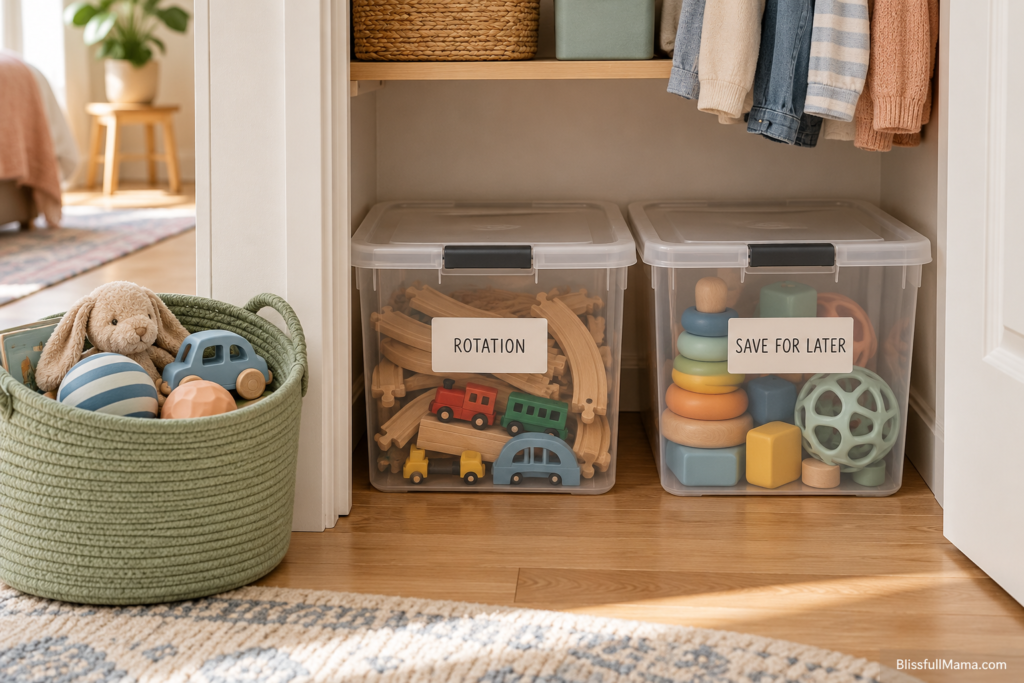
Because our rotation toys sometimes end up mixed in with everything else, clear separation matters more to me than an elaborate schedule.
Try keeping three distinct places:
- Everyday toys: accessible, with simple homes the children understand.
- Rotation toys: stored separately, with contents listed on the outside.
- Toys for younger siblings: labeled with the intended child or stage and a review date.
Choose one rotation box to bring out when the current selection needs a change. Put another selection away during that same swap.
You do not need to rotate on a strict weekly schedule. If your children are happily using what is out, leave it alone.
For favorite categories, keep the core pieces available. A child who regularly builds with magnetic tiles does not need to lose access to them just because the calendar says it is rotation day.
Only Buy Storage After You Know What Is Staying
It is tempting to imagine that the right organizer will make every toy fit.
Sometimes better storage helps. Sometimes it simply gives unused toys another place to sit.
First, check whether you can reuse a basket, shelf, or container you already own. Then identify the exact problem a purchase would solve.
For a larger furniture purchase, the (AD) Guidecraft EdQ 8 Cubby Bin Storage Organizer is one option to compare if you want separate spaces for different toy categories. The manufacturer describes it as storage for toys, books, art supplies, and learning materials. I have not personally tested it. Check its dimensions against your available space and follow the assembly and anchoring instructions.
(AD) Shop Guidecraft EdQ storage options on Amazon.
For rotation, a labeled lidded container you already own may be all you need. Keep stored containers somewhere the younger children cannot access independently.
You can also browse my (AD) Amazon storefront for family and home finds. Buy for a specific need after sorting, not for every “maybe” toy.
Make Room for Christmas Gifts Before They Arrive
Once you know what your children actually use, gift planning becomes more focused.
Keep a short note on your phone with:
- The sets and interests they keep returning to.
- Things they already own.
- Any genuine gaps.
- The space available for something new.
Share specific suggestions with relatives who ask. You might say:
“He’s really enjoying building at the moment. We’re keeping toys manageable, so an addition to his existing set would be lovely.”
When choosing small gifts, browse my stocking stuffers for boys with that same filter: will this be used, and where will it go?
Leave a little breathing room in the toy storage if you can. You do not need to fill every empty space before Christmas.
Your Home Does Not Need a Perfect Playroom
With four boys, I am not aiming for a room that never looks played in.
I want the toys they love to be easier to find. I want fewer mixed piles to sort. And I want saving something for a younger brother to feel like a deliberate choice, rather than a reason nothing can ever leave.
That is a useful goal for toy decluttering before Christmas.
Start with one category. Keep the favorites. Give rotation toys a separate home. Pass along the usable things your family is ready to release.
Then let that finished basket be enough for today.
Want a reminder beside you while you sort? Use the Keep, Donate or Rotate printable to record what stays out, what you are saving for younger siblings, and when your donations will leave the house.
Which toy category is hardest to manage in your home, building pieces, vehicles, stuffed animals, or something else? Tell me in the comments.