
How to Declutter Your Home in One Weekend With Kids
As an Amazon Associate, I earn a small commission from qualifying purchases.
There’s something almost offensive about trying to declutter a house when you have kids.
You spend 20 minutes cleaning one corner, turn around for literally two seconds, and suddenly someone has dumped LEGO pieces, snack wrappers, mismatched socks, and half a dinosaur puzzle all over the floor again.
I used to think the problem was that I wasn’t organized enough. Or disciplined enough. Or productive enough.
Nope.
The real problem is that family clutter grows faster than moms can realistically manage it without a system.
And honestly? A lot of decluttering advice online feels like it was written by people who live alone in white houses with exactly three decorative bowls and one beige throw blanket.
Meanwhile, I live with four boys.
FOUR.
There are shoes everywhere. Tiny cars in places that should physically be impossible. Mysterious paper scraps. Random chargers nobody claims. Empty water bottles multiplying overnight like rabbits.
So if you’ve been staring at your house thinking:
“Where do I even start?”
I get it.
This post is not about making your house look like a minimalist showroom. It’s about helping you make your home feel lighter, calmer, easier to manage, and less mentally exhausting.
And yes, you can absolutely make major progress in one weekend, even with kids home.
Not perfect progress.
Real progress.
The kind where you wake up Monday morning and your brain finally feels quieter.
Before You Start: Don’t Try to Declutter Everything
This is the mistake that burns moms out immediately.
We think:
“I’m going to organize the entire house this weekend.”
Then 3 hours later we’re sitting on the floor surrounded by random cords and expired sunscreen questioning every life choice we’ve ever made.
Instead, your goal this weekend is simple:
- Remove obvious clutter
- Create breathing room
- Make daily life easier
- Reset the most stressful areas
- Stop managing stuff you don’t even use
That’s it.
You do not need color-coded bins and a Pinterest-perfect pantry to feel better in your home.
You just need less chaos.
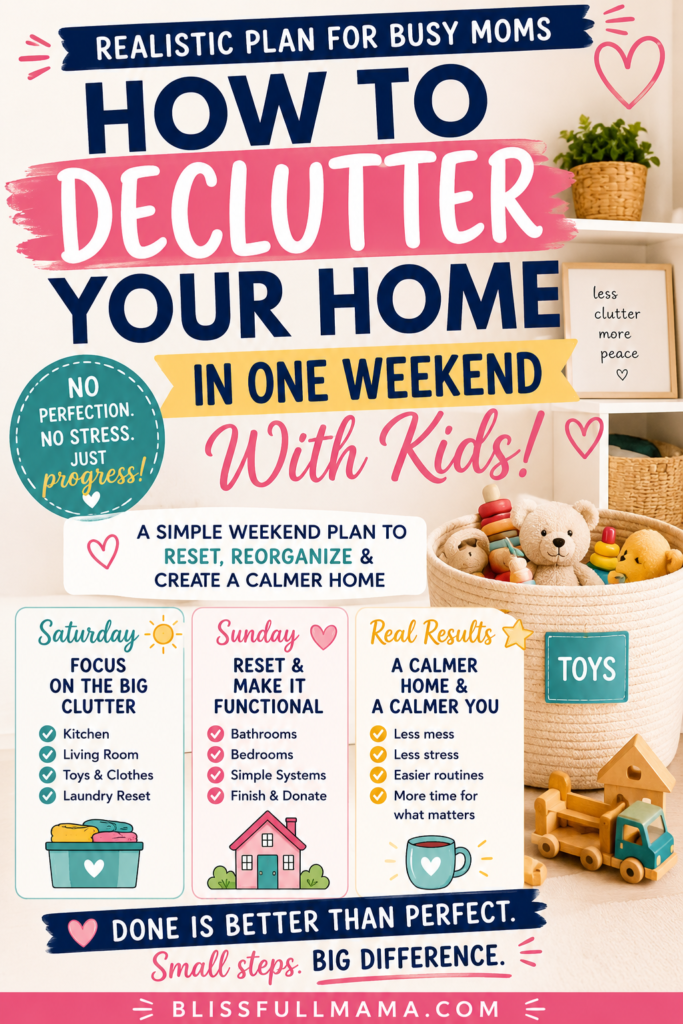
The Weekend Decluttering Plan That Actually Works
This method works because it focuses on momentum instead of perfection.
You are not going room by room trying to create magazine-worthy spaces.
You are targeting the clutter that creates the MOST stress first.
That changes everything.
What You’ll Need Before You Start
You don’t need fancy organization products right away.
Please do not spend $400 on acrylic containers before you even know what you’re keeping.
I’ve made that mistake before.
You mostly need:
- Trash bags
- Donation boxes
- Laundry baskets
- Cleaning wipes
- A timer
- Music or a podcast
- Snacks because decluttering with kids is basically an athletic event
A few things that genuinely help though:
- (AD) Hefty Strong Large Trash Bags
- (AD) Sterilite Storage Baskets
- (AD) Nelko Label Maker Machine with Tape
- (AD) Bissell Little Green Portable Carpet Cleaner
- (AD) Dyson V8 Cordless Vacuum
And if you want easy access to the things I personally recommend for busy moms, I always keep my favorites organized inside my Amazon storefront too.
The Mindset Shift That Changed Decluttering for Me
I used to declutter emotionally.
That sounds dramatic, but hear me out.
I would pick things up and immediately feel guilty.
“What if we need this later?”
“But someone gave us this.”
“My kids used to love this.”
“I spent money on this.”
Meanwhile the item had been sitting untouched for 2 years collecting dust.
One day I realized something:
Keeping too much stuff was making me a more stressed, overstimulated, impatient mom.
That hit me hard.
Because clutter isn’t neutral.
It affects how we function.
It affects how quickly we get overwhelmed.
It affects how much cleaning we constantly have to do.
And honestly, kids don’t need overflowing toy bins to be happy.
Most of the time my boys end up playing with cardboard boxes, blankets, and random sticks outside anyway.
Friday Night: The Secret to Winning the Weekend
Do not start decluttering Saturday morning.
Start Friday night.
Even just 30–45 minutes helps massively.
Friday Night Goals:
- Pick your clutter hotspots
- Gather supplies
- Clear obvious trash
- Mentally prepare
- Get your family on board
I like to walk through the house with a laundry basket and collect:
- random cups
- paper clutter
- abandoned socks
- toys from weird locations
- things that belong upstairs
- things that belong downstairs
This alone makes the house instantly feel less chaotic.
And here’s something important:
Do not organize first.
Declutter first.
Organizing clutter just means creating prettier piles of stuff you still don’t need.
The First Area You Should Declutter
Start with the room that affects your daily stress levels the most.
For most moms, it’s usually:
- the kitchen
- the living room
- the entryway
- or the toy area
Do NOT start with sentimental items.
I repeat:
DO NOT START WITH SENTIMENTAL ITEMS.
You will lose 4 hours crying over baby clothes and accomplish nothing.
Ask me how I know.
Saturday Morning: Start With a Fast Win
Momentum matters more than motivation.
You need a quick visible transformation early in the day so your brain feels rewarded.
That’s why I always recommend starting with:
- visible surfaces
- floors
- counters
- open shelves
Not hidden drawers.
Not memory boxes.
Not your “miscellaneous” cabinet full of expired batteries and mystery cables from 2014.
Visible clutter creates visual stress.
Once surfaces are clear, your whole home immediately feels calmer.
My “Fast Reset” Decluttering Method
Here’s exactly what I do.
I set a timer for 20 minutes and focus ONLY on one category at a time.
For example:
- trash
- laundry
- dishes
- toys
- paper clutter
That’s it.
Not everything at once.
This prevents that horrible overwhelmed feeling where your brain suddenly freezes and you start scrolling your phone instead.
My Favorite Decluttering Rule
If I wouldn’t notice it missing for 6 months…
…it probably doesn’t need to stay.
That rule alone has helped me get rid of so much unnecessary stuff.
Especially:
- duplicate kitchen tools
- random plastic containers
- old decor
- baby items
- clothes nobody wears
- broken toys
- dried-out markers
- mystery cords
Why are mystery cords so aggressive in every house?
Nobody knows what they belong to, but suddenly everyone is emotionally attached to them.
Decluttering With Kids Home (Without Losing Your Mind)
This is the part most decluttering posts completely ignore.
Kids make decluttering harder.
Not impossible.
Just harder.
Because the second you start removing things, suddenly every forgotten toy becomes deeply meaningful.
A truck untouched for 14 months becomes their emotional support vehicle.
Here’s what genuinely helps:
1. Don’t Declutter Everything in Front of Them
Especially younger kids.
Sometimes it’s easier to quietly remove broken toys or obvious clutter while they’re sleeping or distracted.
Not secretly throwing away treasured belongings.
Just removing junk.
There’s a difference.
2. Give Kids a Job
Kids LOVE feeling involved.
Even toddlers can:
- throw trash away
- put toys in bins
- match shoes
- wipe surfaces
- fill donation boxes
My boys actually do better when I give them tiny missions instead of vaguely telling them to “clean your room.”
Specific works better.
3. Use the “Keep Your Favorites” Method
Instead of:
“What do you want to donate?”
Try:
“Let’s pick your favorite toys to keep in this basket.”
That shift feels way less overwhelming for kids.
The Donation Box Trick That Changed Everything
I stopped asking myself:
“Should I get rid of this?”
And started asking:
“Would I buy this again today?”
WOW.
That question exposed so much clutter in my house.
Because keeping things out of guilt is expensive mentally.
Every item in your home requires:
- attention
- storage
- cleaning
- organizing
- managing
Even if you’re not actively using it.
And moms already carry enough mental load.
You do not need extra clutter silently demanding energy from you too.
What to Declutter First for Maximum Impact
If your time is limited this weekend, prioritize these areas first:
1. Kitchen Counters
Nothing changes the feeling of a home faster than clear counters.
Seriously.
Even if the rest of the house is messy, cleaner counters make life feel more manageable.
Start by removing:
- expired food
- duplicate utensils
- random papers
- cups everywhere
- appliances you never use
Keep only what you use weekly on the counters.
Everything else can go away.
My Kitchen Reality Check
I used to think I needed every trendy kitchen gadget.
Then I realized I was constantly moving things around just to cook dinner.
Now I keep my counters much simpler, and cleaning takes a fraction of the time.
That matters when you have kids asking for snacks every 14 seconds.
Helpful Kitchen Organizers I Actually Like
- (AD) YouCopia StoraLid Food Container Lid Organizer
- (AD) SimpleHouseware Pantry Can Organizer
- (AD) OXO Good Grips Drawer Organizer
But again, declutter BEFORE organizing.
Always.
Because containers won’t fix overconsumption.
They just hide it better sometimes.
2. Entryway Clutter
If your entryway looks chaotic, your entire home feels chaotic.
Shoes. Bags. Jackets. Random school papers.
It piles up FAST.
This area deserves systems, not perfection.
A few things that help:
- hooks for backpacks
- one basket per child
- shoe trays
- a donation bin nearby
Simple systems beat complicated organization every single time.
And honestly? Kids are much more likely to maintain easy systems.
Complicated systems usually become mom’s full-time job.
The Emotional Side of Decluttering
Nobody talks enough about this.
Decluttering can bring up guilt, overwhelm, sadness, even embarrassment.
Especially for moms.
Because sometimes clutter represents:
- survival mode
- exhaustion
- lack of time
- emotional spending
- unfinished goals
- seasons of burnout
So if you start decluttering and suddenly feel emotional…
that’s normal.
You are not lazy.
You are not failing.
You are just trying to manage a lot.
Saturday Afternoon: The Toy Decluttering Session
Ah yes.
The part everyone dreads.
The toys.
I genuinely think toys are one of the biggest sources of hidden stress in family homes. Not because kids shouldn’t have toys, obviously. But because they enter the house faster than they leave.
Birthday gifts. Party favors. Happy meal toys. Random impulse buys. Grandparent gifts. Tiny mystery objects from school.
It adds up SO fast.
And the craziest part?
The more toys my kids had, the less they actually played.
The room would get destroyed in 10 minutes, then everyone would complain they were bored.
That was my sign that something needed to change.
The Toy Decluttering Rule That Helped My Kids Most
I stopped trying to organize gigantic toy collections.
Instead, I started reducing the amount available at one time.
That changed everything.
Because kids play better when they can actually SEE what they own.
Too many choices creates overwhelm for them too.
Now I focus on keeping:
- open-ended toys
- favorites
- toys used weekly
- things shared between siblings
- toys that encourage imagination
And I remove:
- broken toys
- missing-piece toys
- noisy junk toys
- things outgrown
- duplicate toys
- toys nobody touches
Honestly, some toys leave the house and nobody notices for months.
Months.
A Few Toy Storage Things That Actually Help
Not decorative systems that look cute for 4 minutes on Pinterest.
I mean realistic systems.
These are genuinely helpful for busy families:
- (AD) IKEA TROFAST Storage Combination
- (AD) Humble Crew Toy Storage Organizer
- (AD) Melissa & Doug Wire Puzzle Storage Rack
- (AD) mDesign Plastic Storage Bins
Low bins work better than complicated organizers for kids.
Especially boys.
If storage requires a 12-step folding system, it’s not surviving real family life.
The “Outgrown” Box Trick
This has saved me so much stress.
I keep one large bin somewhere hidden for:
- clothes too small
- baby items
- toys kids outgrew
- random seasonal stuff
Instead of deciding immediately what to do with everything, I place uncertain items there first.
Then every few months I revisit it.
Most of the time I realize:
“Oh wow, we definitely don’t need this.”
Distance helps you declutter emotionally.
The Truth About Sentimental Clutter
This one is hard.
Especially as moms.
Because everything feels connected to a memory.
Tiny pajamas.
Baby shoes.
Artwork.
Birthday cards.
Little random objects your child handed you with sticky fingers while saying:
“Keep this forever mommy.”
Like excuse me sir, I’m trying not to cry over a broken sticker.
Here’s what helped me:
You do not need to keep every item to keep the memory.
That sentence genuinely changed the way I declutter.
Now I try to keep:
- a few meaningful pieces
- favorite baby outfits
- special photos
- meaningful artwork
- memory boxes with limits
LIMITS are important.
Because unlimited sentimental storage becomes overwhelming fast.
The Container Rule
One memory box per child.
That’s the rule.
When the box fills up, I have to choose what matters most.
And honestly? That makes me value those keepsakes more.
Instead of drowning in piles of paper and random objects I’m too overwhelmed to even look through.
Saturday Evening: The Laundry Reset
Laundry clutter is sneaky because it spreads everywhere.
Clean piles.
Dirty piles.
Mystery piles.
“I wore this once but it’s not dirty” piles.
If your laundry situation feels overwhelming, do not try to perfect it this weekend.
Simplify it.
That’s the goal.
My Realistic Weekend Laundry Reset
Here’s what actually helps me:
1. Declutter Clothes First
Too many clothes creates more laundry chaos.
Not less.
Because:
- drawers overflow
- folding takes forever
- kids dump everything searching for one shirt
- putting laundry away becomes exhausting
Most kids wear the same favorite things repeatedly anyway.
I realized my boys were ignoring half their wardrobes.
So now I regularly remove:
- stained clothes
- uncomfortable clothes
- too-small clothes
- duplicates
- clothes nobody chooses
Less clothing honestly made laundry easier.
Not harder.
The “Would I Wash This Again?” Rule
If I pick something up and think:
“I hate washing this.”
That’s information.
Some clothes are high-maintenance for no reason.
Especially cheap fabrics that wrinkle badly or weird items requiring special care.
Busy moms need easier wardrobes.
Not more complicated ones.
Helpful Laundry Things That Save My Sanity
- (AD) SONGMICS Laundry Sorter with Rolling Bags
- (AD) Utility Slim Storage Cart
- (AD) Scotch-Brite Lint Roller Value Pack
- (AD) Downy Wrinkle Releaser Spray
Tiny conveniences matter when you’re managing laundry for an entire family.
The Closet Decluttering Mistake Most Moms Make
We keep clothes for our fantasy selves.
The organized mom.
The fancy mom.
The “goes out regularly” mom.
The “wears white pants around toddlers” mom.
Meanwhile we’re actually reaching for:
- leggings
- oversized t-shirts
- comfy dresses
- practical outfits
- the same favorite hoodie every week
And honestly?
That’s okay.
Your closet should support your real life.
Not guilt-trip you into becoming another person.
Decluttering Mom Guilt Purchases
This one hurt me personally.
I realized I had clutter from:
- impulse purchases
- stress shopping
- “I deserve this” purchases during hard seasons
- aspirational organizing products
- unfinished hobbies
Sometimes clutter represents hope.
That’s why it’s emotional.
But keeping things you don’t use won’t recover the money.
It just keeps the guilt visible.
That was hard for me to accept.
Saturday Night: Do NOT Keep Going Until Midnight
I know the temptation.
You finally gain momentum and suddenly want to reorganize your entire existence at 1 AM.
Don’t.
Exhaustion leads to bad decluttering decisions and burnout.
Instead:
- take photos of your progress
- celebrate visible wins
- enjoy your cleaner spaces
- rest
Seriously.
Progress counts.
Even if the whole house isn’t done yet.
The Huge Mistake That Creates Re-Clutter
People declutter…
…but they never change what’s ENTERING the house.
That’s why clutter comes back so fast.
If you want lasting results, you have to slow the inflow too.
This doesn’t mean never buying anything.
It just means becoming more intentional.
Questions I Ask Before Bringing Things Home
These questions save me constantly now:
- Where will this live?
- Will this create more work for me?
- Do we already own something similar?
- Will my kids actually use this long term?
- Am I buying this from boredom or stress?
- Is this solving a real problem?
Sometimes the answer is still yes.
But at least it’s intentional.
The Hidden Clutter Most Moms Ignore
Physical clutter isn’t the only problem.
Visual clutter matters too.
Things like:
- overcrowded shelves
- too many decorations
- overloaded bulletin boards
- every surface covered
- too many colors/patterns everywhere
When I simplified some of our visible spaces, the house instantly felt calmer.
Not empty.
Just calmer.
Especially in the living room.
My Living Room Reset Changed My Mood
I’m not exaggerating.
When the main family space feels less chaotic:
- I yell less
- I clean less
- I feel less overstimulated
- bedtime feels calmer
- mornings feel easier
Your environment affects you more than you realize.
Especially as a stay-at-home mom spending all day inside the same space.
Sunday Is NOT About Deep Organizing
This matters.
Sunday is for:
- finishing touches
- donation drop-offs
- resetting systems
- cleaning surfaces
- making the house functional again
Not starting giant complicated projects.
Because if you overdo it Saturday, you’ll spend Sunday overwhelmed and exhausted.
And then Monday feels miserable.
The goal is a calmer home AND a calmer mom.
Not a weekend that destroys you.
Sunday Morning: The Bathroom and Bedroom Reset
By Sunday morning, you’ll probably hit the phase where the excitement wears off a little. Your feet hurt, the kids are cranky, someone has asked for snacks 47 times already, and you suddenly start wondering why you decided to declutter in the first place.
This is normal.
Honestly, this is usually the exact point where most people quit halfway through and leave donation bags sitting in the hallway for the next 6 months. I’ve done that more times than I’d like to admit.
But this is also where the biggest transformation starts happening.
Because once the obvious clutter is gone, you can finally focus on the spaces that affect your daily routines the most. And for me, those spaces are always the bathroom and the bedroom.
Not because they need to look fancy.
Because those are the spaces where I either start the day stressed… or calm.
And wow, clutter changes that fast.
The Bathroom Declutter That Makes Life Easier Immediately
Bathrooms collect clutter so quietly.
Half-used products.
Expired skincare.
Tiny hotel bottles.
Random toddler bath toys.
Medicine nobody uses anymore.
Hair products that disappointed us emotionally and financially.
At one point, I realized I was spending more time moving products around than actually using them.
Now I keep bathrooms much simpler, and cleaning them takes a fraction of the effort.
When you’re busy with kids, easier maintenance matters more than having a perfectly styled bathroom shelf.
What I Remove First in Bathrooms
Whenever I declutter a bathroom, I start with:
- expired products
- empty bottles
- makeup I never use
- old toothbrushes
- duplicate products
- dried-out skincare
- random samples
- broken hair accessories
- old medicines (dispose of safely)
And honestly? The amount of expired stuff I find every single time is slightly embarrassing.
Especially skincare.
I used to buy products thinking they’d magically turn me into a woman who sleeps 8 hours and drinks enough water.
Meanwhile I’m over here surviving on reheated coffee and interrupted sleep.
My Favorite Bathroom Organizers That Actually Help
Not the tiny decorative trays that only hold 2 cotton pads and a dream.
I mean useful things.
- (AD) SimpleHouseware Under Sink Organizer
- (AD) mDesign Plastic Bathroom Storage Bins
- (AD) Acrylic Makeup Organizer Drawers
- (AD) iHave Toothbrush Holders
I also keep my favorite home and organizing finds inside my Amazon storefront.
Decluttering Kids’ Bathroom Stuff
Why do tiny humans own 900 bath toys?
And somehow all of them trap mysterious water inside forever.
One of the best things I ever did was massively reduce bath toy clutter.
Not remove all the fun.
Just simplify it.
Because fewer toys meant:
- less moldy junk
- easier cleanup
- calmer bath time
- less visual chaos
Now I rotate bath toys occasionally instead of keeping everything available at once, and honestly my boys still play exactly the same.
Kids usually need less than we think.
Your Bedroom Should Not Feel Like Storage
This one hit me personally.
There was a period where our bedroom basically became the “temporary holding area” for everything I didn’t know what to do with.
Laundry baskets.
Random boxes.
Packages.
Kids’ stuff.
Donation piles.
Things waiting to be put away “later.”
Except later never came.
And eventually the room that should feel restful started feeling stressful instead.
That affects you mentally more than people realize.
Especially moms.
Because when your bedroom feels cluttered, it’s hard to actually relax at the end of the day. Your brain keeps scanning unfinished tasks everywhere.
The Bedroom Declutter Focus Areas
You do NOT need to organize every drawer this weekend.
Focus on high-impact areas first:
- nightstands
- visible surfaces
- laundry piles
- floor clutter
- under-bed chaos
- overflowing dressers
That alone changes the whole feeling of the room.
And honestly, waking up in a calmer bedroom affects your entire mood in the morning.
The Nightstand Reset That Helped My Anxiety
This sounds dramatic, but decluttering my nightstand genuinely helped me sleep better.
Because mine used to collect:
- receipts
- random cups
- tangled chargers
- hair ties
- unfinished notebooks
- medicine
- snack wrappers
- kids’ toys somehow
Now I keep only:
- a lamp
- my current book
- charger
- lip balm
- water
That’s it.
Tiny change.
Huge difference.
Sunday Afternoon: Create Simple Systems
This is the part people skip.
Decluttering matters, but systems are what KEEP the house manageable afterward.
And the keyword here is simple.
Busy moms do not need complicated systems.
We need systems tired people can still follow.
That’s very different.
My “Lazy-Proof” Home Systems
If a system requires too much effort, nobody maintains it.
Including me.
So now I create systems based on real life, not fantasy life.
For example:
Shoes
Instead of expecting perfectly lined-up shoes in closets, we use simple baskets near the entryway.
Because realistically, that’s where the shoes end up anyway.
School Papers
Instead of stacks everywhere, each child has one designated basket.
Not perfect.
Just contained.
Toys
Open bins instead of complicated sorting categories.
Because kids clean up faster when the system makes sense to THEM.
Laundry
I stopped pretending I enjoy folding tiny clothes perfectly.
Now I simplify wherever possible because survival matters more than aesthetic folding techniques.
One of the Biggest Decluttering Truths
A lot of household stress comes from having too many decisions.
Too many clothes.
Too many toys.
Too many products.
Too many random objects competing for attention.
Decluttering reduces decision fatigue.
That’s why it feels mentally lighter afterward.
You’re not imagining it.
The “Everything Needs a Home” Advice Is Incomplete
People love saying:
“Everything needs a home.”
But honestly?
Sometimes the real problem is that there are simply too many things in the house.
No amount of bins can fix excess.
That realization changed how I organize forever.
Because organization products are helpful AFTER decluttering.
Not before.
And I say that as someone who absolutely loves cute containers.
My Favorite Decluttering Question Now
Instead of asking:
“Where can I store this?”
I ask:
“Do I even want to manage this item anymore?”
Very different energy.
Because every single item you keep becomes part of your mental workload.
Especially as the default household manager.
The Donation Drop-Off Rule
Do not let donation bags sit in your trunk for 8 months.
Please.
Get them OUT quickly.
Otherwise clutter has a sneaky way of slowly migrating back into the house.
Ask me how I know.
Now I try to schedule donation drop-offs immediately or arrange pickups when possible.
The faster clutter leaves physically, the more complete the reset feels emotionally too.
Decluttering When You’re Emotionally Attached to Stuff
This part deserves honesty.
Sometimes we keep clutter because we’re scared.
Scared we’ll need it later.
Scared we wasted money.
Scared of regret.
Scared of letting go of a season of life.
Especially motherhood seasons.
Baby items are HARD.
Tiny clothes should honestly come with emotional warning labels.
But here’s something I remind myself constantly:
My children deserve a present, peaceful mom more than they need me storing 37 bins of baby things forever.
That perspective helps me let go slowly and realistically instead of drowning in guilt every time I declutter something sentimental.
Your House Does Not Need to Be Perfect
I really need moms to hear this part.
A decluttered home with kids will STILL look lived in.
There will still be messes.
Laundry.
Snack crumbs.
Backpacks.
Tiny socks appearing in strange locations.
That’s normal family life.
The goal is not perfection.
The goal is creating a home that feels easier to live in.
A home that supports you instead of constantly overwhelming you.
And honestly, even reducing the chaos by 30% can completely change how your home feels day to day.
What Happened After I Started Decluttering Regularly
One thing I didn’t expect after decluttering was how much easier everyday motherhood started feeling.
Not easy.
Just… lighter.
I wasn’t spending 45 minutes looking for missing shoes every morning.
I wasn’t constantly moving piles from one room to another.
Cleaning became faster because there was less stuff in the way.
The house reset quicker at night.
And honestly, my brain felt less noisy.
That part surprised me the most.
Because clutter is not just physical. It’s visual and mental too.
When every surface is crowded, your brain never fully rests. You’re constantly seeing unfinished tasks everywhere you look.
And as moms, especially stay-at-home moms, we spend SO much time inside our homes that the environment affects us deeply whether we realize it or not.
The Maintenance Rule That Keeps Clutter From Returning
Here’s the truth nobody tells you:
Decluttering is never fully “done” when you have kids.
Stuff constantly enters the house.
School papers.
Birthday gifts.
Clothes.
Crafts.
Tiny plastic things nobody remembers buying.
That’s why maintenance matters more than one giant perfect decluttering session.
Now I try to do small resets constantly instead of waiting until the house becomes unbearable again.
Honestly, this mindset shift changed everything for me.
Instead of:
“I need to deep clean the entire house.”
I think:
“What can I reset in 10 minutes right now?”
That feels manageable.
And if you loved this realistic approach to home management, you’d probably also enjoy my post about creating a realistic cleaning routine for busy moms because that routine honestly works hand-in-hand with decluttering.
The Daily Cleaning Schedule That Keeps My House from Falling Apart (Even with 4 Kids)
My Weekly “Mini Declutter” Routine
This helps prevent the massive overwhelming clutter buildup.
Every week I quickly reset:
- the entryway
- fridge leftovers
- bathroom counters
- toy overflow
- random paper piles
- kids’ clothes drawers
Nothing intense.
Usually 10–15 minutes per area.
And wow, staying on top of clutter a little at a time is SO much easier than trying to rescue the entire house in one exhausting weekend every month.
The Truth About Organizing Products
I love organization products.
I really do.
But I had to learn the hard way that containers alone don’t solve clutter problems.
Sometimes they actually hide the problem temporarily.
I used to buy bins before decluttering because I thought organization would magically fix everything.
Instead, I ended up with organized clutter.
Now I follow this rule:
Declutter first.
Organize second.
Buy containers LAST.
That order matters so much.
My Favorite High-Impact Organizing Products
These are things that genuinely made everyday life easier in our house instead of just looking cute online.
- (AD) Dyson V8 Cordless Vacuum
- (AD) Bissell Little Green Portable Carpet Cleaner
- (AD) Tineco Floor ONE S5 Smart Wet Dry Vacuum Cleaner
- (AD) Sterilite Storage Baskets
- (AD) Command Wall Hooks
The biggest difference-makers are usually products that reduce friction in daily cleaning and tidying, not complicated systems.
Decluttering and Motherhood Guilt
Moms carry SO much guilt around the home.
We feel guilty for:
- the mess
- not being organized enough
- buying too much
- wasting money
- not keeping sentimental things
- not being “that mom” with the perfect house
But honestly?
A home with children is supposed to look lived in.
Your house is not a museum.
And sometimes survival seasons create clutter seasons. That doesn’t make you lazy or incapable.
It makes you human.
There were periods where I was so overwhelmed with motherhood and daily life that decluttering felt impossible. I could barely keep up with basic cleaning, let alone organize every cabinet.
If you’re in that season right now, start smaller than you think you need to.
One drawer.
One basket.
One counter.
Tiny progress still changes the atmosphere of a home.
The Areas That Usually Give the Biggest “Before and After” Feeling
If you’re short on time, prioritize these first because they create the biggest visible impact quickly:
1. Kitchen Counters
Clear counters instantly make the house feel cleaner and calmer.
2. Living Room Floor
Especially if toys tend to explode everywhere by noon.
3. Entryway
A chaotic entrance makes the entire home feel stressful before you even walk in fully.
4. Bathroom Counters
Removing clutter here makes mornings feel smoother immediately.
5. Laundry Overflow
Nothing mentally drains me faster than endless clothing piles.
And if laundry feels like one of your biggest stress points too, my post about realistic self-care habits for busy moms talks honestly about creating routines that actually fit motherhood instead of perfection.
10 Self-Care Habits Busy Moms Can Actually Stick To
One Thing I Stopped Buying Completely
Tiny trendy organizers for random categories.
You know the ones.
The hyper-specific containers that organize exactly 14 yogurt pouches at a 37-degree angle.
Listen.
If it helps you genuinely function better, amazing.
But I realized I was sometimes buying organization products because I wanted to FEEL organized instead of simplifying the actual problem.
Now I focus much more on reducing excess first.
And honestly, owning less means needing fewer systems overall.
What Decluttering Changed for My Kids
This surprised me too.
Once the clutter reduced:
- my boys played better
- cleanup got easier
- they fought less over toys
- bedtime routines felt calmer
- they could actually find their things
Kids often function better with less visual overwhelm too.
Not empty rooms.
Just simpler spaces.
And if you’re trying to create calmer routines overall, my post about building a calmer family morning routine connects really well with this because clutter and rushed mornings absolutely feed each other.
10 Tips for Creating a Calm and Organized Morning Routine for the Whole Family
Realistically, How Much Can You Declutter in One Weekend?
More than you think.
Especially if you stop aiming for perfection.
Most moms waste time:
- overthinking
- reorganizing instead of removing
- getting emotionally stuck
- trying to make everything Pinterest-perfect
But if you focus on removing obvious clutter first, you can create HUGE visible progress in just 2 days.
Enough to make your home feel dramatically different by Monday morning.
And honestly, that momentum matters.
Because once you experience how much calmer your house feels with less clutter, it becomes easier to keep going little by little afterward.
My Honest Advice If You Feel Overwhelmed
Don’t wait until you have:
- more time
- more energy
- older kids
- a perfect plan
- fancy containers
- a free weekend with zero interruptions
Because honestly?
That perfect moment probably isn’t coming.
Start imperfectly.
Declutter while your toddler dumps toys behind you.
Declutter while reheating your coffee three times.
Declutter while life is still messy.
Progress inside a real family home will never look perfect.
But it still counts.
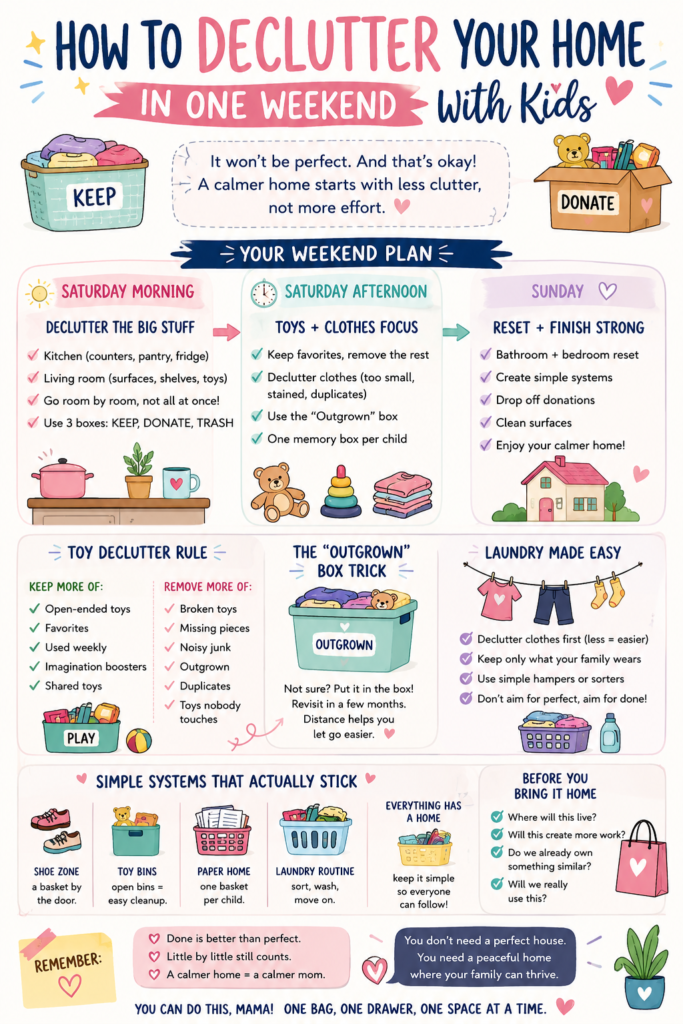
Save this post for later!
If your house feels overwhelming right now, pin this realistic decluttering guide so you can come back to it during your next reset weekend.
Final Thoughts
If your house feels overwhelming right now, I want you to know something important:
You do not need to become a minimalist mom to feel better in your home.
You do not need spotless rooms.
You do not need matching bins.
You do not need a professionally organized pantry.
You probably just need less.
Less visual noise.
Less excess.
Less pressure.
Less stuff demanding your attention every second.
And little by little, that creates more room for what actually matters:
rest, connection, peace, and enjoying your family without constantly feeling behind.
Even if your decluttering weekend only gets you halfway there, that’s still meaningful progress.
Because every bag removed, every surface cleared, and every simplified system is making your home work FOR you instead of against you.
One Comment
Comments are closed.