Best Backpacks for Elementary Boys That Actually Last All School Year
As an Amazon Associate, I earn a small commission from qualifying purchases.
The best backpacks for elementary boys are not always the biggest, most expensive, or covered in the coolest characters. The right one fits your child, holds the supplies his school actually requires, and has strong enough straps, seams, and zippers for daily use.
As a mom of four boys, with one heading into fourth grade and another into second grade, I know a school backpack is rarely treated gently. It gets dropped, pulled by one strap, overfilled with library books, and placed suspiciously close to leaking water bottles.
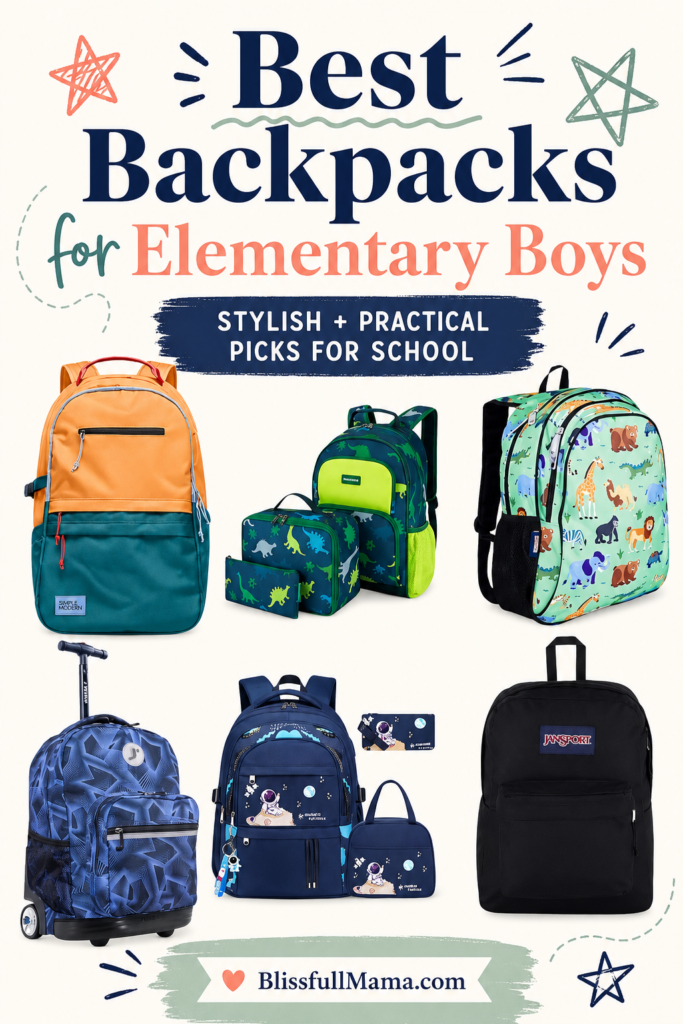
I narrowed this guide to six backpacks that serve genuinely different needs. I have not personally tested every bag here, so I compared current dimensions, capacity, materials, organization, and intended age range rather than pretending otherwise.
Backpack colors, designs, prices, and availability can change. Always confirm the measurements on the exact product listing before ordering.
Quick Picks: Best Elementary Backpacks for Boys
| Backpack | Best for | Size or capacity | Main advantage |
| Wildkin 15-Inch Backpack | Kindergarten–second grade | 15 liters | Child-sized and folder-friendly |
| Simple Modern Fletcher Large | First–fourth grade | 18 liters | Character designs with practical features |
| L.L.Bean Original Book Pack | First grade and up | 24 liters | Premium construction and classic style |
| JanSport SuperBreak Plus | Taller third–fifth graders | 26 liters | Lightweight with room to grow |
| Under Armour Hustle Lite | Older elementary and sports days | 26.5 liters | Water-resistant with a coated bottom |
| J World Sunrise Rolling Backpack | Heavy loads when school permits wheels | 18 x 13 x 9 inches | Can be rolled instead of carried |
My simplest recommendation:
Choose the Wildkin or mommore for a younger elementary child, the Simple Modern Fletcher or ACESAK if he wants something fun, and the JanSport SuperBreak Plus for a taller fourth or fifth grader.
You can also browse more school gear and practical finds for boys in my (AD) Blissful Mama Amazon Storefront.
How to Choose the Right Backpack Size
Backpack size matters more than the grade printed in a product description. Two boys in second grade can have completely different heights and carry very different school supplies.
A young child usually does not need a huge backpack “to grow into.” An oversized bag can hang below his waist, pull away from his back, and tempt everyone to pack more than he needs. On the other hand, a tiny preschool backpack may not hold a standard folder without bending it.
Before ordering, check the backpack’s height and width against your child’s back. The top should sit near his shoulders, and the bottom should not hang far below his waist. Adjust the straps so the bag stays close to his body instead of sagging toward his hips.
As a practical starting point:
- Kindergarten through second grade: Look for a backpack around 14–16 inches tall and approximately 15–18 liters.
- Second through fourth grade: Look for a backpack around 15–17 inches tall and approximately 18–24 liters.
- Fourth through fifth grade: Look for a backpack around 16–18 inches tall and approximately 22–28 liters, depending on the child and school requirements.
These are only starting ranges. Check whether your child must carry a two-inch binder, Chromebook, lunch box, sweatshirt, library books, or extra clothes. A child who leaves most supplies at school can use a much smaller backpack than one who brings everything home daily.
The American Academy of Pediatrics advises that a loaded backpack should not weigh more than about 15 percent of a child’s body weight. A child leaning forward to support the backpack is another warning that it is too heavy. (HealthyChildren.org)
Before buying school gear, use my back-to-school shopping list by grade to check what your child genuinely needs instead of filling his backpack with unnecessary extras.
1. Wildkin 15-Inch Backpack: Best for Younger Elementary Boys
Best for: Kindergarten through second grade
The (AD) Wildkin 15-Inch Backpack is my best overall choice for a younger elementary boy because it is sized like a children’s backpack without becoming too small for actual school supplies.
Wildkin lists this size at 15 x 11 x 7 inches with a 15-liter capacity. It has two zippered compartments, one mesh bottle pocket, and enough space for standard folders, notebooks, books, a sweatshirt, and up to a two-inch binder. The brand places this size in its kindergarten-through-second-grade range.
The two-compartment layout is useful without being confusing, and the 15-inch height should feel more manageable on a kindergartener than the oversized sports bags often included in school backpack roundups. The main limitation is the single bottle pocket.
Choose it when: Your child needs a fun, practical backpack for early elementary school and carries a moderate amount of supplies.
2. Simple Modern Fletcher Large: Best Character Backpack
Best for: First through fourth grade, depending on the child’s height
The (AD) Simple Modern Fletcher Kids Backpack is a good compromise when your child wants Minecraft, Spider-Man, dinosaurs, or another fun design, but you still want real backpack features.
The large Fletcher measures 16.5 x 13 x 6.25 inches, holds 18 liters, and includes a sleeve for devices up to 15 inches. Simple Modern also includes a chest strap, padded shoulder straps, a front pocket, and two bottle pockets.
The chest strap can help on narrower shoulders, and two bottle pockets are useful when one side is needed for an umbrella. There is a smaller 12-liter Fletcher, but it can become crowded after adding a folder, lunch bag, library book, and sweatshirt.
Choose it when: The design matters to your child and you want something more functional than a thin novelty character bag.
3. mommore Kids Backpack: Best Backpack Set for Younger Elementary Boys
Best for: Ages 4–8, kindergarten through second grade
The (AD) mommore Kids Backpack for Boys Girls 4–8 Kindergarten Elementary School Backpack with Lunch Box – 15” H Fit Folder is a smart choice for younger elementary boys because it is clearly designed for little kids who still need a real school bag.
What immediately makes this one practical is the size. The product is listed as 15 inches high and able to fit folders, which is exactly the kind of detail moms need when shopping for kindergarten and early elementary kids. Many cute backpacks look great online but turn out to be too small for school papers. This one seems to hit that sweet spot between child-sized and school-ready.
I also like that it comes as a matching set, which makes school mornings simpler. A coordinated backpack, lunch box, and pencil pouch can make everything feel more organized, especially if your child is still learning how to keep up with his own things. The dinosaur print is fun without being too babyish, and the bright green details make it easy to spot.
This kind of backpack works especially well for boys who do not need to carry a huge load yet but still need room for folders, snacks, and basic school supplies.
Choose it when: Your child is in kindergarten, first grade, or second grade and you want a cute, practical school set that feels age-appropriate.
4. JanSport SuperBreak Plus: Best for Older Elementary Boys
Best for: Taller third graders through fifth graders
The (AD) JanSport SuperBreak Plus is my top choice for an older elementary boy who needs more room but does not need a giant multi-compartment backpack.
It measures 16.5 x 12.5 x 5.5 inches, holds 26 liters, and weighs about 14 ounces empty. It is made with 600-denier recycled polyester and includes one large main compartment, a laptop sleeve, a front organizer pocket, and a side bottle pocket. JanSport also lists a limited lifetime warranty.
Its biggest advantage is the combination of capacity and low empty weight. The drawbacks are the missing chest strap and single main compartment, which may not suit a child separating schoolwork from sports clothes.
Choose it when: Your third-, fourth-, or fifth-grader needs a lightweight, straightforward backpack with room for a device and everyday school supplies.
5. ACESAK Backpack Set: Best Fun Backpack Set for Elementary Boys
Best for: Elementary boys who want a fun design and a matching set
The (AD) ACESAK Backpack for Boys – Boy Backpack Schoolbag for Boys Kids Children Teens Girls Elementary Middle School Bags, Waterproof Lightweight Kids Bookbag Backpacks Casual Daypack with Lunch Bag Set is a good pick for boys who care about how their backpack looks but still need something practical enough for school.
This set stands out because it includes a matching backpack, lunch bag, and pouch, which makes it feel like a full school kit instead of just a backpack. The space-themed design is especially cute for younger boys, and it gives the bag personality without looking too plain or too grown-up. If your child gets excited about things like astronauts, planets, or anything space-themed, this kind of backpack can make school gear feel more fun.
According to the listing, it is also described as waterproof and lightweight, which are both helpful features for everyday school use. Lightweight matters because a child’s backpack gets heavy quickly once you add a lunch box, water bottle, folders, and school papers. A matching lunch bag also helps moms avoid the daily struggle of trying to make mismatched items fit together.
This one looks best suited for elementary-age boys who want something playful and eye-catching while still having the basics needed for school.
Choose it when: Your child wants a fun backpack design, and you want the convenience of a matching lunch bag set.
6. J World Sunrise Rolling Backpack: Best Rolling Option
Best for: Older students with heavy loads, when rolling backpacks are allowed
The (AD) J World Sunrise Rolling Backpack is an alternative for a child who regularly carries a genuinely heavy load and can roll his bag through most of the school day.
It measures 18 x 13 x 9 inches and includes a large main compartment, a front organizer, two mesh bottle pockets, cushioned shoulder straps, and a telescoping handle. J World says the main compartment can hold textbooks, a laptop, lunch, and smaller items.
A rolling bag reduces the time spent carrying a heavy load, but it is bulky, awkward on stairs, and harder to lift into a car or bus. Some schools do not permit wheels, so check the rules before ordering.
Choose it when: Your older child struggles with a heavy backpack, his school permits rolling bags, and his route does not involve many stairs.
What Makes a Backpack More Likely to Last?
No backpack is guaranteed to last all year, but these details improve the odds:
Reinforced Straps and Seams
Check where the shoulder straps connect to the bag and where the top handle is stitched. These areas carry the most pressure and often fail before the fabric itself.
Smooth, Easy-to-Grab Zippers
Ask your child to open the bag around the corners. A zipper that catches when the backpack is empty is unlikely to improve once the bag is packed.
A Sturdy Bottom
A coated or reinforced bottom helps protect against rough floors, dirt, and small spills. This feature matters even more for children who place their backpacks outdoors during pickup or sports practice.
Padded, Adjustable Shoulder Straps
The straps should be wide enough to avoid digging into the shoulders and adjustable enough to keep the bag close to the child’s back.
An Exterior Water Bottle Pocket
Keeping water outside the main compartment protects homework and library books. Make sure the pocket is deep enough to hold your child’s actual bottle rather than trusting the product photo.
The Five-Minute Backpack Test
When the backpack arrives, do not remove the tags immediately. Pack it with the items your child normally carries: his largest folder or binder, lunch box, water bottle, school device, and sweatshirt.
Then ask him to wear it with both straps and walk around the house. Check that:
- The backpack stays between his shoulders and waist.
- The straps do not slide off.
- He can stand upright without leaning forward.
- The water bottle stays securely inside its pocket.
- He can open every zipper without help.
- The fully packed backpack does not feel unnecessarily heavy.
This quick test is more reliable than choosing by age alone and can save you from discovering the sizing problem on the first morning of school.
A lunch box that fits inside the backpack makes daily packing much easier. My guide to the best lunch boxes for elementary kids includes practical options for different appetites and school routines.
Frequently Asked Questions
What Is the Best Backpack Size for a First Grader?
Most first graders do well with a backpack around 14–16 inches tall and approximately 15–18 liters, provided it holds the school’s required folder or binder.
A small child may need less, while a taller first grader carrying a device may need slightly more. Measure your child and check the school supply list before buying.
Is a 30-Liter Backpack Too Big for Elementary School?
For most elementary students, yes. A 30-liter bag is often more space than they need and can encourage overpacking.
A tall fifth grader carrying school and sports gear may use that capacity, but it is usually excessive for kindergarten through third grade.
Should an Elementary Backpack Have a Chest Strap?
A chest strap is helpful but not mandatory. It can stop the shoulder straps from slipping and keep the backpack more stable, particularly on a small or narrow-shouldered child.
Fit, total weight, and properly adjusted shoulder straps still matter more than the chest strap alone.
How Can I Make My Child’s Backpack Last Longer?
Teach him to carry it using the top handle or both shoulder straps instead of dragging it by one strap. Empty food and water bottles daily, wipe spills quickly, and remove unnecessary papers every week.
Follow the manufacturer’s cleaning instructions rather than automatically putting the backpack in the washing machine.
Is an Expensive Backpack Always More Durable?
No. A higher price may reflect stronger materials, better stitching, a warranty, or a premium brand, but it can also reflect licensing and design.
Check construction and fit before price. The best value is the bag your child can comfortably use all year.
Final Thoughts
The best backpack is not the one with the most pockets or the trendiest brand name. It is the one that fits your child well, holds the supplies he actually needs, and can handle everyday school life without falling apart halfway through the year.
For younger elementary boys, I would start with the Wildkin 15-Inch Backpack or the mommore Kids Backpack. If your child wants something more fun and playful, the Simple Modern Fletcher Large and the ACESAK Backpack Set are both great options to consider. For older elementary boys who need more room, the JanSport SuperBreak Plus is still the most practical all-around choice.
Once you choose the backpack, the next step is creating an easy evening routine so it actually gets packed and ready before the morning rush. My realistic back-to-school routine for busy moms can help with that.
You can also browse more school gear and practical finds for boys in the (AD) Blissful Mama Amazon Storefront.
This is so helpful as the kids are getting ready to head back to school. Finding the right backpack can make or break their day. It needs to be sturdy, roomy for all their school supplies, and, of course, they need to like it. Love these tips!
Thank you, Karen! A sturdy, roomy backpack that kids actually like makes such a difference. I’m glad you found the tips helpful!