
15 School Supply Organization Hacks That Keep the Clutter Under Control
As a mom of four boys, I’ve learned that buying school supplies is the easy part. The real challenge is stopping pencils, glue sticks, notebooks, worksheets, and broken crayons from slowly taking over the kitchen table.
These simple school supply organization hacks will help you create a practical system that your kids can actually maintain, even when you have limited space and several children using the same supplies.
As an Amazon Associate, I earn from qualifying purchases.
(AD) Browse my favorite school organization products in my Amazon storefront.
Start With a Quick School Supply Inventory
Before buying another box of pencils, gather the supplies you already have from:
- Backpacks
- Desk drawers
- Craft bins
- Kitchen cabinets
- Last year’s pencil cases
- Random baskets around the house
Sort everything into simple categories such as writing, coloring, paper, cutting, gluing and school technology.
Every year, I’m surprised by how many perfectly good supplies are already hiding around our home. Taking inventory first prevents duplicate purchases and shows you exactly how much storage you really need.
My free back-to-school checklist for moms can also help you work through the rest of your school preparations without trying to remember everything at once.
1. Separate Everyday Supplies From Extra Supplies
One of the most useful school supply organization hacks is keeping daily supplies separate from your backup stock.
Your child probably needs only:
- Five or six sharpened pencils
- One eraser
- One glue stick
- One pair of scissors
- One box of crayons or colored pencils
Keep these items in the homework area. Store the unopened packages and replacements somewhere else.
When children have access to every pencil, marker and glue stick you own, they tend to spread everything out. A smaller daily supply makes the area easier to use and faster to clean.
2. Create One Central Supply Station
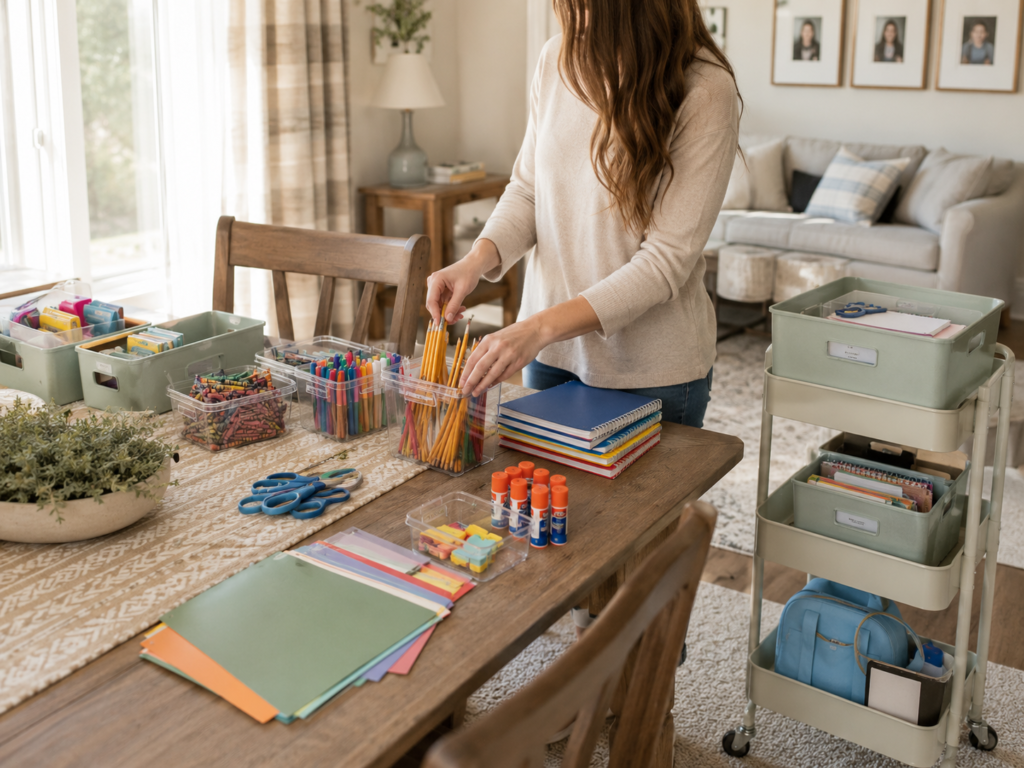
Instead of storing school supplies in five different rooms, choose one main location for everything.
This could be:
- A rolling cart beside the kitchen table
- A small cabinet in the playroom
- A shelf inside a hallway closet
- A cube organizer near the homework area
- A set of drawers under a desk
We don’t have a separate school room, so I prefer systems that can fit into the rooms we already use. A small section of the playroom or dining area is enough when every item has a clear home.
For help setting up the complete space, see my guide to homework station must-haves for kids.
3. Use a Rolling Cart for Shared Supplies
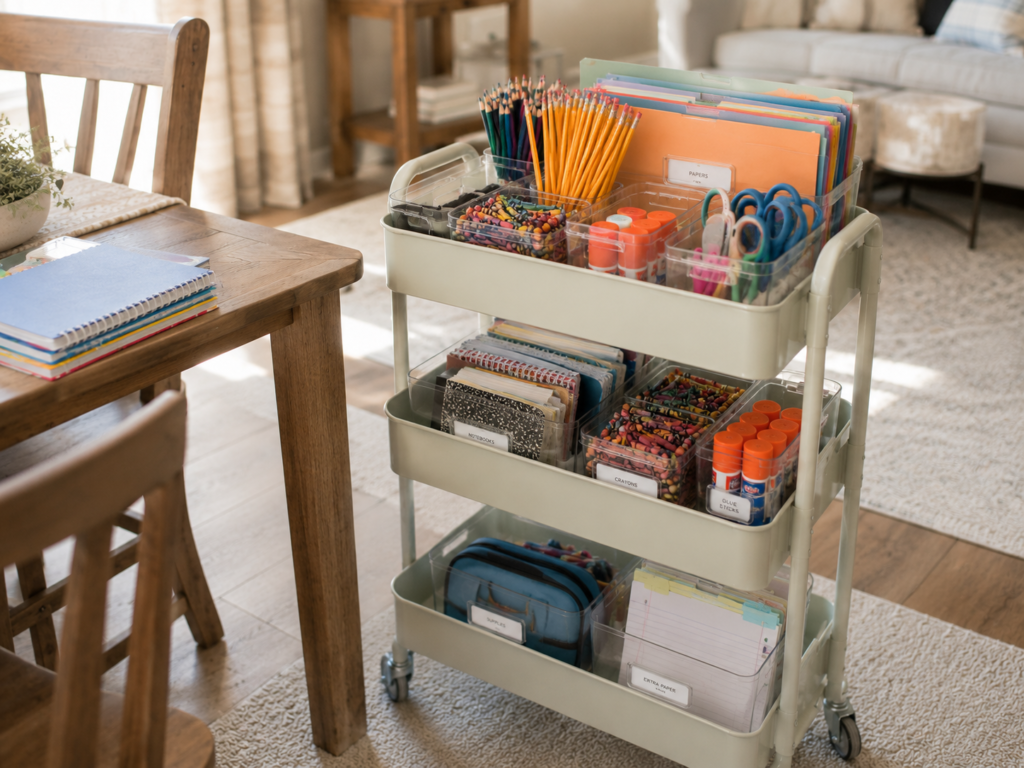
A rolling cart is especially useful when your children complete homework at the kitchen or dining table.
You can organize it by level:
- Top: Pencils, erasers, scissors and frequently used supplies
- Middle: Coloring materials, glue and craft supplies
- Bottom: Paper, notebooks, flashcards and backup supplies
The cart can stay beside the homework table during the afternoon and roll away when homework is finished.
For a family with several school-age children, a sturdy multi-drawer cart is one higher-cost purchase that may replace several smaller containers.
(AD) Shop rolling carts, drawer units and school storage in my Amazon storefront.
4. Give Each Child a Portable Homework Caddy
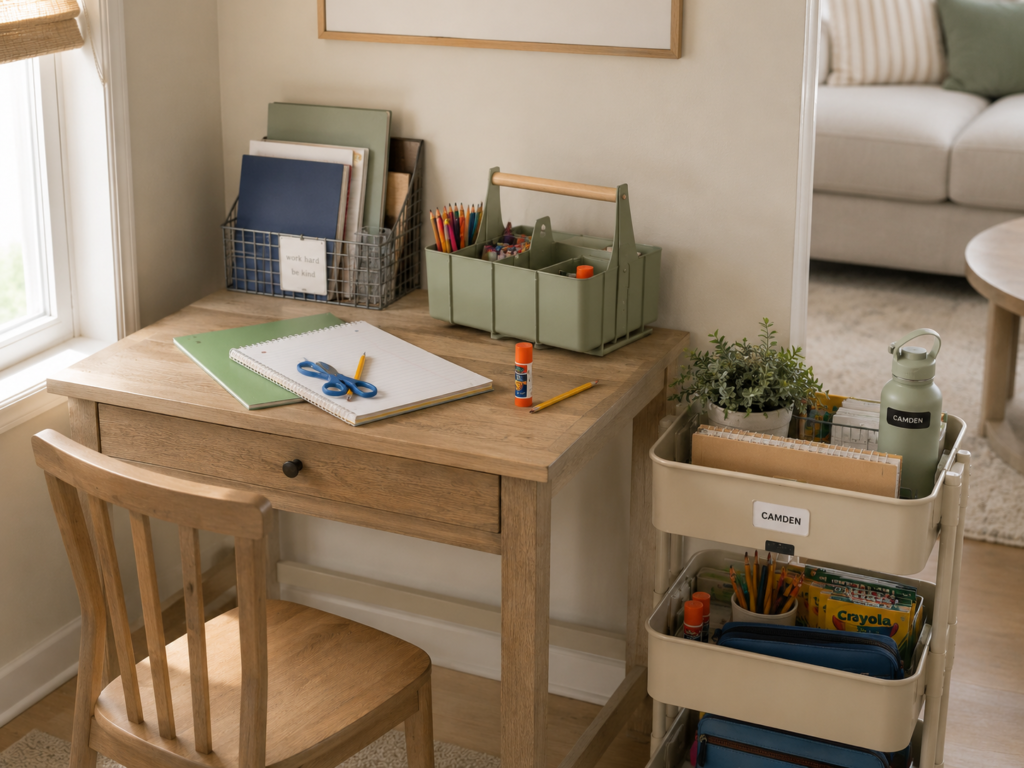
Shared supplies are convenient, but each child should also have a small homework caddy or pencil pouch containing his basic tools.
My older boys sometimes need to work in different areas, especially when one child needs quiet and another needs help. A portable caddy allows each boy to carry his supplies without emptying the entire organization cart.
Include:
- Sharpened pencils
- Eraser
- Highlighter
- Scissors
- Glue stick
- Colored pencils
- Small ruler
At the end of homework time, the entire caddy returns to the supply station.
5. Organize Supplies by Category, Not by Package
Remove bulky packaging whenever it makes sense and group similar supplies together.
For example, create separate containers for:
- Pencils and pens
- Erasers and sharpeners
- Crayons and colored pencils
- Markers
- Glue and tape
- Scissors and rulers
- Flashcards and learning tools
Avoid creating overly specific categories such as separate bins for red pens, blue pens and black pens. The more complicated the system becomes, the less likely children are to follow it.
The goal is not to make the supplies look like a professional craft store. The goal is to help your child find a pencil without asking you where it is.
6. Choose Clear Drawers or Open Containers
Clear drawers make it easier to see when supplies are running low. Open-top containers also work well for younger children who may struggle with tight lids.
When choosing containers, consider how your child will actually use them.
A beautiful stack of matching lidded boxes may look organized, but it will not stay organized if your children find the lids difficult to open and close.
Use the simplest container that does the job.
(AD) Find clear drawers, storage bins and homework caddies in my Amazon storefront.
7. Label Every Container Clearly
Labels remove the question of where something belongs.
Use short, obvious labels such as:
- Pencils
- Markers
- Glue
- Paper
- Notebooks
- Extra Supplies
- Return to School
For preschoolers and early readers, add a small picture or colored symbol beside the word. Your child does not need to read perfectly to recognize a pencil picture or a green dot.
A label maker can make the system look neat, but handwritten labels work just as well.
(AD) Shop label makers and reusable storage labels in my Amazon storefront.
8. Assign Each Child a Color
When several children use similar supplies, choose one color for each child.
You can use colored:
- Pencil pouches
- Folders
- Water bottles
- Labels
- Binder tabs
- Storage baskets
For example, one child might use blue labels while another uses green. This makes it much easier to identify who left a notebook on the table or whose permission slip still needs to be returned.
You do not need to buy everything in matching colors. A strip of colored tape or a colored name label is enough.
9. Store Paper Vertically
Stacks of paper become messy quickly because children pull sheets from the middle and leave the rest sliding across the shelf.
Use a vertical file holder or magazine organizer for:
- Printer paper
- Construction paper
- Lined paper
- Drawing paper
- Finished artwork
- Extra notebooks
Vertical storage also helps you see what you have without lifting several piles.
Keep only a reasonable amount of paper in the homework station. Store bulk packages separately and refill the organizer when necessary.
10. Create a System for School Papers
School papers need their own system or they will end up on the kitchen counter.
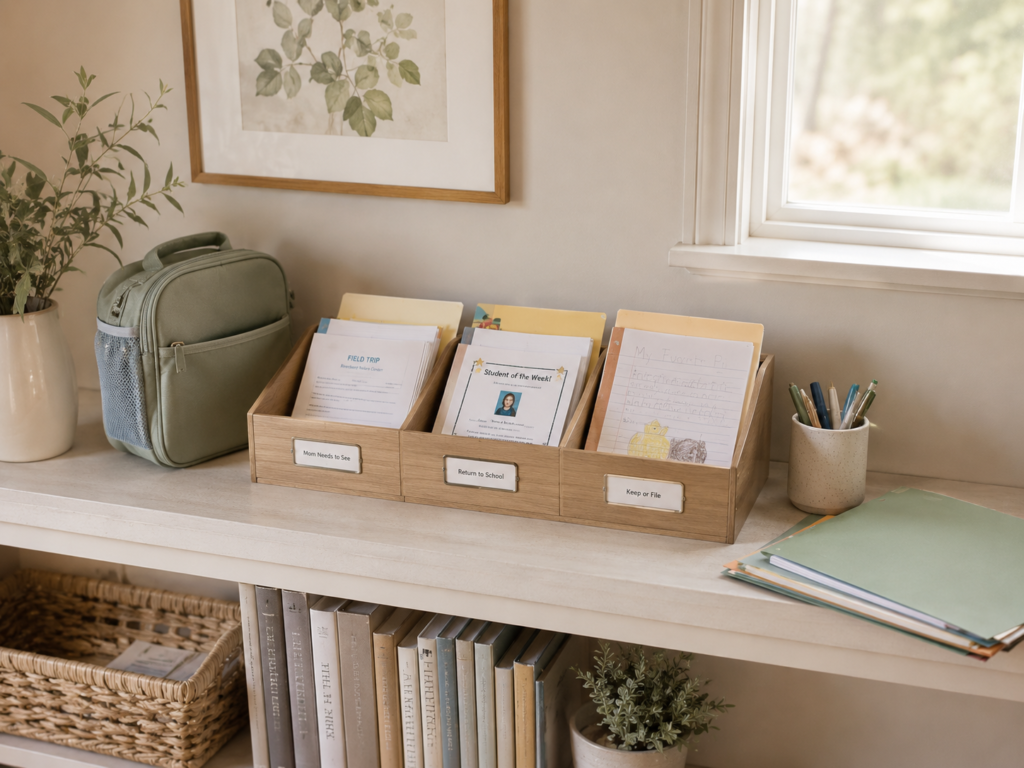
Create three clearly labeled sections:
- Mom Needs to See: Permission slips, forms and teacher notes
- Return to School: Signed papers, homework and library books
- Keep or File: Important records, report cards and special work
Ask your children to empty their backpacks into the correct section as part of their after-school routine.
This takes only a few minutes, but it prevents important papers from disappearing underneath snack wrappers and unfinished worksheets.
11. Keep a Small Supply Refill Bin
Create one container for unopened backup supplies.
This might include:
- Extra pencils
- Glue sticks
- Erasers
- Crayons
- Notebook paper
- Index cards
- Tissues
- Pencil pouches
Store this bin on a higher shelf or inside a closet rather than in the daily homework area.
Before buying more supplies, check the refill bin. This small habit can prevent the yearly cycle of buying new glue sticks while an unopened package is already hiding in the house.
12. Store Messy Art Supplies Separately
Paint, glitter, permanent markers, ink pads and large bottles of glue do not need to live beside everyday homework supplies.
Keep messy materials in a separate, adult-controlled container. Bring them out when you are ready for a craft activity and put them away afterward.
This is particularly helpful when you have a toddler who believes every container exists for his personal investigation.
Washable crayons, pencils and basic paper can remain accessible. Anything that could decorate the walls, sofa or younger sibling should live somewhere safer.
13. Use Doors and Walls in Small Spaces
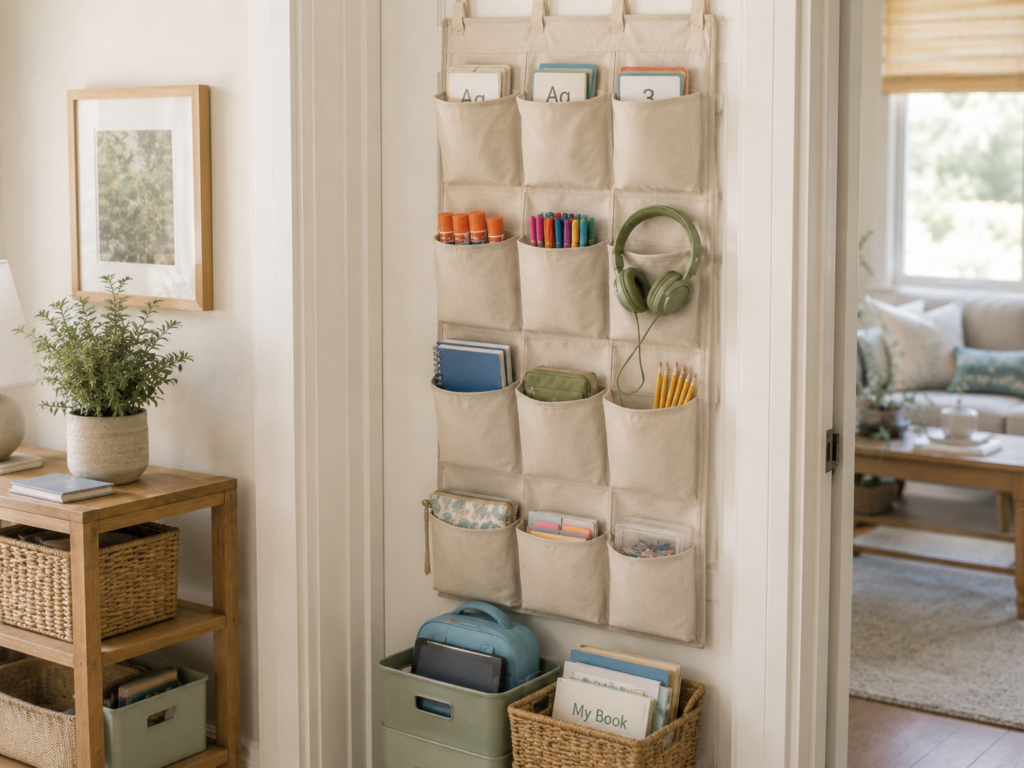
When floor and shelf space are limited, look for unused vertical space.
Try:
- An over-the-door pocket organizer
- Wall-mounted file holders
- Pegboards
- Hooks for pencil pouches
- Hanging baskets
- A narrow wall shelf
An over-the-door organizer can hold calculators, flashcards, glue, headphones and small notebooks without taking up any floor space.
Avoid placing heavy or sharp items in hanging organizers that younger children can reach.
14. Create a Five-Minute Friday Reset
No organization system will stay perfect for an entire school year. The solution is not creating a stricter system, it is scheduling a quick reset.
Every Friday, have the kids:
- Return supplies to the correct containers
- Throw away broken crayons and scraps
- Sharpen pencils
- Refill empty caddies
- Clear old papers
- Check glue sticks and erasers
This can become one of their regular age-appropriate chores.
A five-minute weekly reset is much easier than facing a completely disorganized homework station once a month.
15. Keep the System Easy Enough for Your Children
The best school supply organization system is not necessarily the prettiest one. It is the one your family can use without Mom managing every step.
Before choosing a storage solution, ask:
- Can my child reach it?
- Can he open it independently?
- Does he understand the labels?
- Can he put supplies away quickly?
- Is there enough room for the items without stuffing them in?
My boys are much more likely to clean up when putting supplies away requires one or two simple actions. If they have to open three containers, move a basket and carefully arrange every marker, the system will slowly fall apart.
What You Really Need to Organize School Supplies
You do not need to purchase an entire matching collection.
A practical setup may include:
- One rolling cart or drawer unit
- Two or three clear containers
- One homework caddy per child
- A vertical file organizer
- Labels
- One backup supply bin
- One school-paper station
Start with containers you already own. After using the system for a few weeks, you will know whether a larger drawer cart, cabinet or label maker would genuinely help.
See all my favorite organization and school products in my Amazon storefront.
Grab the Free School Supply Organization Kit
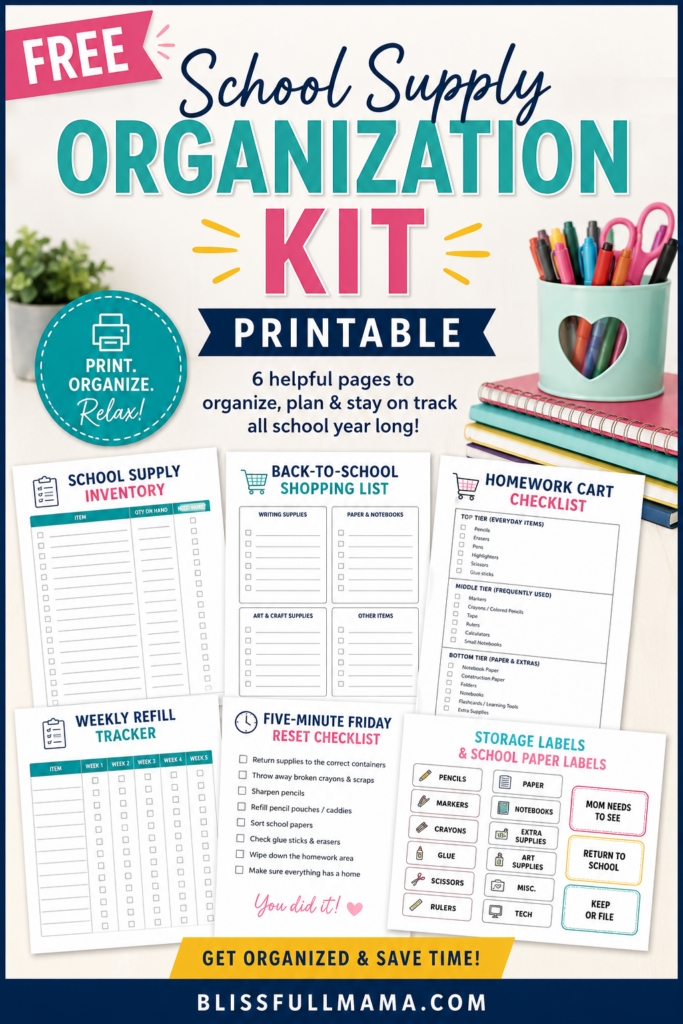
Tired of buying duplicate supplies, losing important school papers, or realizing you’re out of glue sticks right when homework starts?
Download the free School Supply Organization Kit to keep everything in one place and make weekly school prep feel much easier.
Inside, you’ll get:
- A school supply inventory sheet
- A back-to-school shopping list
- A homework-cart checklist
- A weekly refill tracker
- A five-minute Friday reset checklist
- Printable storage labels
[Get the Free School Supply Organization Kit]
Final Thoughts
School supply organization does not need to involve a perfectly styled homework room or dozens of expensive containers.
For our family, the biggest difference comes from keeping everyday supplies together, storing extras separately and making cleanup simple enough for the boys to handle themselves.
Start with one small area. Gather what you already own, create a home for each category and add labels your children understand.
These small school supply organization hacks can save time during homework, reduce unnecessary purchases and make your school-day routines feel much calmer.
More Back-to-School Help for Busy Moms
Continue getting ready for the school year with these helpful resources:
This is so helpful! Thanks for sharing
These school supply organization hacks are a great way to set everyone up for a successful school year.