
How to Set Up a Kids Chore Chart That Actually Works [Free Printable Checklist]
Because yelling “Can someone PLEASE pick up the socks?!” 14 times a day is not a sustainable system.
As an Amazon Associate, I earn a small commission from qualifying purchases.
If you’ve ever spent 30 minutes cleaning the living room just for your kids to destroy it in 4.7 seconds… welcome. You are absolutely my people.
I used to think chore charts were only for those super organized moms with color-coded bins, matching labels, and children who happily wipe counters while classical music plays in the background.
Meanwhile, my reality looked more like:
- someone crying because they had the wrong cup,
- LEGO under my foot,
- towels on the bathroom floor,
- and me rage-cleaning while muttering, “Why am I the only person who knows how to throw trash away?”
So I’d make chore charts.
Cute ones.
Pinterest-worthy ones.
And my kids would ignore them within two days.
Sometimes within two hours.
The problem wasn’t that my kids were lazy. And honestly? The problem wasn’t even the chart itself.
The problem was that I was creating chore systems for my fantasy family instead of my actual family.
Busy moms do this all the time. We create routines that look amazing online but completely collapse in real life because they require:
- too much consistency,
- too much energy,
- too much supervision,
- or children who apparently don’t exist outside Instagram reels.
What finally changed things in our house was simplifying everything.
Not perfecting it. Simplifying it.
And today I want to walk you through exactly how to create a kids chore chart system that:
- actually gets used,
- helps your kids become more responsible,
- reduces constant nagging,
- works for different ages,
- and doesn’t create even more work for you.
Because let’s be honest: if the system takes more effort to maintain than just doing the chores yourself… moms quit using it.
And I don’t blame them.
Why Most Chore Charts Fail
Before we talk about what works, we need to talk about why most chore systems completely fall apart.
Because once I realized these mistakes, everything became easier.
1. The chores are too complicated
Kids need clarity.
“Clean your room” sounds simple to us, but to a child? That task feels enormous.
They look around and see:
- toys,
- clothes,
- random papers,
- stuffed animals,
- water bottles,
- mystery crumbs,
- and three socks with no matching pair.
Their brain basically shuts down.
What works better:
- Put dirty clothes in basket
- Make bed
- Put toys in bins
- Throw away trash
Tiny steps.
Kids respond much better to specific instructions than giant overwhelming tasks.
2. Moms accidentally make the chart too ambitious
This one hurt me personally.
I’d start with:
- morning chores,
- after-school chores,
- evening chores,
- hygiene tracking,
- reading goals,
- gratitude prompts,
- habit tracking,
- responsibility points,
- reward systems…
Basically a full-time management position for everyone involved.
By day four, I was exhausted trying to maintain the system.
Simple systems survive.
Complicated systems die.
Always remember that.
3. The chores aren’t age-appropriate
A toddler cannot “deep clean.”
And honestly, some adults don’t deep clean either.
When chores are too hard, kids resist because they feel incapable. Then moms interpret that as laziness when really the child is overwhelmed.
The goal is success.
You want your child to think:
“I can do this.”
That confidence matters.
4. There’s no consistency
This is the hardest part for busy moms.
Especially when we’re tired.
Sometimes it feels easier to just do the task ourselves than explain it 37 times.
I still struggle with this.
But consistency matters more than perfection.
Not “perfect every day” consistency.
Just enough repetition that kids understand:
“This is part of our family routine now.”
The Real Goal of a Chore Chart
This surprised me when I finally understood it.
The goal is NOT:
- a spotless house,
- perfect behavior,
- robotic obedience,
- or making your kids “earn their keep.”
The real goal is raising capable humans.
That’s it.
Kids need to learn:
- responsibility,
- teamwork,
- independence,
- life skills,
- and contribution.
And honestly? Chores help kids feel needed.
Even if they complain the whole time.
My boys still dramatically sigh like I asked them to work in a coal mine when I say:
“Please put your shoes away.”
But I’ve noticed something important:
they actually feel proud when they help.
Kids love competence.
They love feeling capable.
That’s why little kids constantly say:
“Let me do it!”
Even when it takes 14 years longer.
What Age Should Kids Start Doing Chores?
Honestly? Much younger than most people think.
Even toddlers can help in tiny ways.
The key is adjusting expectations.
Here’s a realistic breakdown:
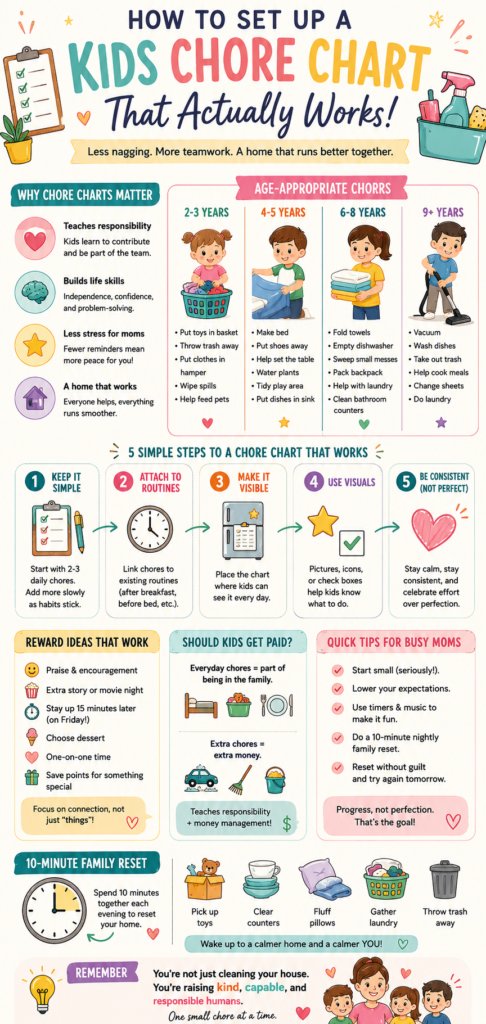
Ages 2–3
- Put toys in basket
- Throw trash away
- Put dirty clothes in hamper
- Wipe spills
- Carry diapers
- Help feed pets
At this age, chores are mostly about habit-building.
Do not expect perfection.
You are planting seeds.
Ages 4–5
- Make bed (messily counts)
- Put shoes away
- Help set table
- Match socks
- Water plants
- Tidy play area
- Put dishes in sink
This is the golden age where kids still think helping is fun.
Take advantage of it before they discover attitudes.
Ages 6–8
- Fold towels
- Empty dishwasher
- Sweep small messes
- Pack backpack
- Help with laundry
- Clean bathroom counters
- Organize toys/books
This age can actually handle real responsibilities.
Not perfectly. But genuinely helpfully.
Ages 9+
- Vacuum
- Wash dishes
- Take out trash
- Help cook simple meals
- Clean bathroom
- Change sheets
- Do laundry
By this age, kids are capable of much more than many parents realize.
Sometimes we accidentally hold onto control because it’s faster to do it ourselves.
But long term? Teaching them helps everyone.
Including future roommates and spouses.
You’re welcome, society.
The Chore Chart System That Finally Worked in My House
After trying way too many complicated systems, here’s what finally worked for us:
Step 1: Pick ONLY 3 Daily Chores
That’s it.
Not 17.
Three.
Especially when starting.
For example:
- Make bed
- Put dirty clothes away
- Tidy toys before bed
Simple.
Predictable.
Repeatable.
Once those become habits, you can slowly add more.
Step 2: Attach Chores to Existing Routines
This changed everything.
Kids struggle with random expectations.
But routines are easier to remember.
For example:
- After breakfast → clear dishes
- Before screen time → tidy living room
- Before bed → quick toy pickup
The routine becomes the reminder instead of you constantly yelling.
That matters.
Step 3: Keep the Chart Visible
If kids can’t see it, it basically doesn’t exist.
Good places:
- fridge,
- hallway,
- bedroom wall,
- command center,
- inside pantry door.
Visual reminders help SO much.
Especially for younger kids.
Step 4: Use Pictures for Younger Kids
Even if your child can read, visuals help.
You can use:
- icons,
- photos,
- clipart,
- check boxes,
- magnets,
- Velcro charts.
Little kids love visual progress.
And honestly? Adults do too.
That’s why crossing things off a to-do list feels amazing.
Step 5: Don’t Constantly Rescue Them
This one is hard.
Painfully hard.
Because moms naturally jump in.
But if every unfinished chore gets rescued immediately, kids learn:
“Mom will eventually do it.”
Natural consequences work better.
Not harsh punishment.
Just follow-through.
For example:
- Toys left out get temporarily put away
- Dirty uniform not in laundry may not be clean tomorrow
- Messy desk stays messy until cleaned
Real-life consequences teach responsibility better than lectures.
Should Kids Get Paid for Chores?
Ah yes. The parenting debate.
Honestly? I think there’s room for nuance here.
I personally believe some chores should simply exist because you’re part of the family.
Things like:
- making bed,
- picking up toys,
- helping clean shared spaces,
- putting dishes away.
Those are life responsibilities.
Not paid jobs.
BUT…
I also think extra chores can absolutely earn money.
That teaches:
- work ethic,
- money management,
- delayed gratification.
For example:
- washing the car,
- organizing garage,
- extra yard work,
- helping with deep cleaning.
That balance has worked much better for us than paying for every tiny task.
Because I don’t want my kids asking:
“How much will you pay me to put my plate away?”
Sir. You live here.
Rewards That Work Better Than Constant Bribery
Let’s talk rewards because this gets misunderstood a lot.
You do NOT need:
- giant prizes,
- expensive toys,
- daily gifts,
- or complicated point systems.
Actually, too many rewards can backfire.
Kids start expecting payment for basic responsibilities.
Instead, focus on:
- praise,
- consistency,
- visual progress,
- occasional incentives.
Some realistic reward ideas:
- extra story at bedtime
- choosing movie night
- staying up 15 minutes later Friday
- choosing dessert
- one-on-one mom time
- sticker chart leading to something small
And honestly?
You’d be surprised how motivating simple praise can be.
Especially when it’s specific.
Instead of:
“Good job.”
Try:
“I noticed you cleaned up without me asking. That was really responsible.”
That hits differently.
The Biggest Mistake I Made With Chores
I treated chores like punishment.
Not intentionally.
But emotionally.
I’d assign chores mostly when I was already overwhelmed and angry.
So chores became connected to tension.
Now I try much harder to present chores as:
“this is how we take care of our home together.”
That mindset shift matters.
Because home should feel shared.
Not like mom is the exhausted unpaid manager of everyone’s mess.
And honestly? That resentment builds fast when moms carry the entire mental load alone.
Especially in motherhood.
Realistic Chore Chart Rules for Busy Moms
Here’s what I want you to remember:
“Good enough” counts
If the bed is messy but made? Count it.
If toys are mostly picked up? Count it.
Perfection kills consistency.
Don’t start during chaos
Don’t launch a huge new system during:
- holidays,
- sickness,
- stressful seasons,
- newborn exhaustion,
- school transitions.
Start small during a relatively normal week.
Expect pushback
Kids test boundaries.
That doesn’t mean the system isn’t working.
It means they’re kids.
Stay calm. Stay consistent.
Reset without guilt
If the system falls apart for a week?
Restart.
No shame spiral.
Moms do not need another reason to feel like failures.
You’re building habits, not running a military academy.
My Favorite Chore Chart Supplies for Moms
You absolutely do NOT need fancy supplies.
Paper works.
A whiteboard works.
Sticky notes work.
But if you want a system that feels easier and more motivating, these are genuinely helpful.
Magnetic chore charts
These are great for fridges and younger kids.
Dry erase boards
Perfect for reusable daily routines.
Visual routine cards
Amazing for toddlers and preschoolers.
(AD) Visual Routine Cards for Kids
Toy storage bins
Half the battle is making cleanup easier.
(AD) Toy Storage Bins and Organizers
Label maker
Not necessary. But honestly satisfying.
(AD) Label Makers for Home Organization
Chore Charts and the Mental Load of Motherhood
This part matters.
A lot.
Sometimes moms hesitate to involve kids in chores because:
- it feels slower,
- messier,
- harder at first.
And yes… sometimes it is.
But long term?
Teaching your kids to contribute helps protect you from burnout.
Mothers carry an invisible workload that people seriously underestimate.
The remembering.
The planning.
The noticing.
The constant managing.
And when moms do literally everything alone for years, resentment builds.
Quietly.
Slowly.
Then one day you’re irrationally furious because someone left a spoon on the counter.
But it’s not about the spoon.
It’s about feeling unsupported.
That’s why teaching kids responsibility matters beyond just cleanliness.
It creates a family culture where everyone contributes.
Not just mom.
And honestly? That’s healthier for kids too.
If Your Kids Resist Chores, Read This
Resistance does NOT mean failure.
It’s normal.
Especially in the beginning.
Stay patient.
Stay boring.
Stay consistent.
You don’t need:
- endless lectures,
- screaming matches,
- complicated punishments.
You just need repetition.
Children learn through repetition far more than emotional speeches.
And over time?
The routines become normal.
That’s when things finally start feeling easier.
Not perfect.
But easier.
And as a mom of four boys, I’ll take easier.
Related Posts for Busy Moms
- “The Daily Cleaning Schedule That Keeps My House from Falling Apart”
- “15-Minute Cleaning Hacks Every Mom Should Know”
- “Nightly Reset Routine for Busy Moms”
- “The 10-Minute-a-Day Cleaning Routine That Actually Works”
Common Chore Chart Problems (And How to Fix Them)
One thing I wish more parenting content talked about is this:
Even the best chore chart will not magically transform your house overnight.
There will still be:
- whining,
- forgotten tasks,
- random emotional meltdowns,
- and at least one child acting personally victimized because you asked them to carry their own plate to the sink.
That’s normal.
What matters is creating systems that slowly reduce chaos over time instead of expecting instant perfection.
And honestly, that mindset shift helped me more than any printable ever did.
Because I used to quit chore systems the second things got messy.
If my kids skipped chores for two days, I’d think:
“Well, that failed.”
But successful family systems are not successful because nobody messes up.
They work because the family keeps returning to them.
That’s it.
That’s the secret.
Problem #1: Kids “Forget” Their Chores Constantly
This one used to drive me insane.
Because HOW do you forget the same thing every single day?!
But then I realized something important:
Kids depend heavily on visual cues and repetition.
Especially younger kids.
A chore chart hidden in a corner won’t help.
And verbal reminders disappear into the void after about three seconds.
So instead of repeating myself endlessly, I started using environmental reminders.
Things like:
- chore charts on the fridge,
- baskets labeled clearly,
- hooks at kid height,
- visual routines,
- toy bins with pictures,
- laundry baskets in easy places.
Basically:
make the desired behavior easier.
This matters more than we realize.
Even adults struggle with systems that create too much friction.
If the toy basket is upstairs while toys pile up downstairs… cleanup becomes harder.
If shoes don’t have a designated spot… they’ll end up everywhere.
Organization should support behavior.
Not fight against it.
Problem #2: Moms Become the “Chore Police”
This is SUCH an easy trap.
You create the chart hoping it’ll reduce mental load…
…but suddenly you’re:
- monitoring,
- reminding,
- checking,
- correcting,
- enforcing,
- negotiating,
- and managing the entire system yourself.
Which somehow becomes MORE exhausting.
That’s why I stopped micromanaging every detail.
Now I focus on:
- consistency,
- simple expectations,
- and routines over perfection.
For example, instead of:
“Fold every blanket perfectly.”
I care more about:
“Did the blankets get put away?”
Done is better than perfect.
Especially in motherhood.
Problem #3: Everything Falls Apart on Busy Days
This used to happen constantly in our house.
School chaos.
Appointments.
Sick kids.
Bad sleep.
Overstimulation.
Life.
And suddenly nobody is following the routine anymore.
Now we use what I call:
“minimum survival mode chores.”
Basically:
the non-negotiables during hard seasons.
For us, that usually means:
- dirty clothes in baskets,
- dishes in sink,
- toys picked up before bed,
- backpacks ready for school.
That’s it.
Not perfection.
Just enough to keep the house functioning.
And honestly? This approach saved me from the all-or-nothing mindset that used to destroy every routine I tried.
The Best Chore Chart Styles for Different Types of Kids
Not every child responds to the same system.
This is important.
Some kids LOVE structure.
Others resist anything that feels controlling.
So instead of forcing one system, it helps to match the chart to your child’s personality.
For Visual Kids: Picture Charts
These work especially well for toddlers and preschoolers.
Use:
- icons,
- photos,
- simple illustrations,
- magnets,
- Velcro pieces.
Visual kids respond much faster when they can SEE what’s expected.
And honestly, younger kids feel proud moving pieces around or checking boxes.
It makes chores feel tangible.
(AD) Reusable Visual Chore Charts for Kids
For Competitive Kids: Point Systems
Some children LOVE earning points.
You can keep it simple:
- 1 point per completed task,
- points trade for rewards,
- weekly family reward goal.
But keep the rewards manageable.
Do NOT create a system where you’re spending money constantly.
That becomes exhausting fast.
Some free reward ideas:
- choosing dinner,
- movie night choice,
- picnic,
- staying up later Friday,
- baking with mom,
- extra reading time together.
Connection is often more motivating than stuff.
For Independent Kids: Checklist Systems
Older kids often prefer checklists because they feel more grown-up.
Instead of:
“Mom telling me what to do.”
It becomes:
“Here’s what needs to happen before free time.”
That subtle difference matters.
Especially as kids get older.
You want responsibility to feel empowering, not humiliating.
Chores That Secretly Teach Important Life Skills
One thing I love about chores is that they teach WAY more than cleaning.
They build skills kids will use forever.
For example:
Laundry teaches:
- responsibility,
- sequencing,
- independence,
- delayed gratification.
Cleaning teaches:
- ownership,
- discipline,
- care for shared spaces.
Cooking teaches:
- confidence,
- practical life skills,
- patience,
- creativity.
Organizing teaches:
- problem-solving,
- decision-making,
- systems thinking.
And honestly?
A child who learns how to contribute at home grows into an adult who understands teamwork better.
That matters.
A lot.
The “10-Minute Family Reset” That Changed My Evenings
This is probably the single most effective thing we’ve ever done.
Every evening:
everyone helps reset the house for 10 minutes.
Not deep cleaning.
Not perfection.
Just resetting.
We:
- pick up toys,
- clear counters,
- fluff couch pillows,
- put shoes away,
- gather laundry,
- throw trash away.
And the difference this makes emotionally is HUGE.
Waking up to a semi-reset house instantly reduces stress.
Not completely.
But noticeably.
Especially for moms.
Because visual clutter affects mental overwhelm more than people realize.
How I Handle Chores When I’m Exhausted
This part is important because motherhood burnout is real.
There are days when:
- the baby barely slept,
- the older kids are loud,
- I’m overstimulated,
- and the LAST thing I want is another battle over chores.
On those days, I simplify aggressively.
I stop trying to run the house like a productivity expert online.
Instead, I focus on:
- keeping the kitchen functional,
- keeping pathways clear,
- basic hygiene,
- tomorrow’s essentials.
That’s it.
I think moms sometimes feel guilty for not maintaining Pinterest-level homes constantly.
But real homes, especially homes with children are lived in.
Your worth is not measured by spotless countertops.
And honestly?
Some seasons are survival seasons.
That doesn’t mean you’re failing.
Why I Don’t Believe in Perfectly Clean Homes With Kids
This might be unpopular, but I’ll say it anyway:
I don’t think constantly spotless homes are the ultimate motherhood goal.
I really don’t.
I care far more about:
- emotional safety,
- connection,
- routines,
- warmth,
- peace,
- laughter,
- and functionality.
Of course I want my house reasonably clean.
But I no longer want a home that feels stressful because everyone is terrified of making messes.
Kids live loudly.
Especially boys.
There are shoes.
Snacks.
Blankets.
Markers.
Random sticks from outside.
Tiny LEGO weapons hidden everywhere.
That’s childhood.
And honestly, one day the mess will disappear.
I try to remember that when I’m overwhelmed.
Even though in the moment I still sometimes fantasize about living alone in a silent hotel room with no crumbs on the floor.
The Best Chores for Kids Who Hate Cleaning
Some kids like my eldest son resist cleaning because it feels boring or overwhelming.
What helped us:
- setting timers,
- making cleanup races,
- using music,
- breaking tasks into tiny jobs,
- cleaning together instead of isolating kids.
Sometimes companionship matters more than motivation.A so
Even adults clean better when someone else is nearby.
That’s why “body doubling” works so well.
Kids are the same.
Instead of:
“Go clean your room.”
Try:
“Let’s reset this together for 10 minutes.”
That small change reduces resistance SO much.
Why Moms Need to Stop Doing Everything Alone
This is honestly bigger than chore charts.
Modern motherhood quietly expects women to:
- manage the house,
- remember appointments,
- cook,
- clean,
- organize,
- emotionally regulate everyone,
- manage school life,
- maintain routines,
- AND somehow stay calm and grateful through all of it.
It’s too much for one person.
And one of the healthiest things we can do is teach our kids:
“This home belongs to all of us. We all help care for it.”
Not in a shame-based way.
Not in a harsh way.
Just realistically.
Because children who contribute grow up understanding that homes require teamwork.
And moms deserve support too.
Chore Chart Ideas by Room
Bedroom Chores
- make bed
- put pajamas away
- dirty clothes in hamper
- tidy toys
- organize bookshelf
Bathroom Chores
- wipe sink
- hang towels
- restock toilet paper
- put dirty clothes away
- throw trash away
Kitchen Chores
- clear dishes
- wipe table
- unload dishwasher
- feed pets
- help prepare snacks
Living Room Chores
- fold blankets
- organize pillows
- pick up toys
- vacuum crumbs
- tidy baskets
Outdoor Chores
- water plants
- sweep porch
- put bikes away
- help wash car
- collect sports equipment
Fun Free Kids Chore Chart Checklist
Want to make chores feel less stressful and more manageable for your family? I created this fun free Kids Chore Checklist Printable to help your kids build responsibility one small task at a time without constant nagging from mom. Just print it out, hang it on the fridge, and let your kids start checking things off proudly!
Grab your free printable below and start creating calmer, more helpful routines at home.
Just enter your email and I will send it your way
Final Thoughts
If chore charts have failed in your home before, please don’t assume you failed as a mom.
Most families don’t need stricter systems.
They need simpler ones.
That’s the difference.
Start tiny.
Lower the pressure.
Expect imperfection.
Focus on consistency over intensity.
And remember:
the goal is not raising children who obey instantly and maintain magazine-worthy bedrooms.
The goal is raising humans who:
- contribute,
- care,
- help,
- and eventually know how to function independently in the real world.
That matters far more than perfectly folded towels.
Great tips! This will be helpful for my littles!
Thank you so much! I’m glad you found the tips helpful. 😊 I hope your little ones enjoy helping out and gain confidence through chores too!