
Summer Daily Routine for Boys: How to Survive Summer With Multiple Kids Without Losing Your Mind
As an Amazon Associate, I earn a small commission from qualifying purchases.
Welcome to Summer Chaos, or Is It?
It’s 8:47 in the morning.
Your 9-year-old is already in a full argument with your 7-year-old over who controls the TV. Your 4-year-old has dragged every single Lego bin into the hallway. And your 2-year-old just dumped an entire cup of apple juice on the carpet.
It’s only been awake for 47 minutes.
Summer with boys is a whole different animal. The energy is relentless. The noise is constant. The boredom complaints start before breakfast. And if you don’t have some kind of structure in place, the whole summer can feel like one long, loud, exhausting loop with no end in sight.
I’ve lived this. Four boys, ages 9, 7, 4, and 2. Every summer I tried a different approach, and I’ll be honest — the first couple of summers I had no routine at all. I thought, they’re kids, let them be free.
What actually happened: more fighting, more boredom meltdowns, more screen time by default, and me running on empty by week 2.
The summer routine I’m sharing here is the one that finally worked. It’s not rigid. It’s not a military schedule. It’s a simple, realistic time-block system built specifically for boys who have energy to burn, brothers to drive each other crazy, and a mom who desperately needs breathing room too.
Let’s get into it.
Why Boys Specifically Need Summer Structure
Boys are not smaller versions of girls when it comes to energy and behavior. That’s not a stereotype — it’s developmental reality. Boys, especially in the 2-9 age range, tend to be more physically driven, more impulsive, and more prone to conflict when they’re bored or understimulated.
Without structure, summer becomes a pressure cooker. Too many unscheduled hours with no direction is a recipe for fighting, destruction, and meltdowns.
What boys need in summer isn’t entertainment — it’s rhythm. A loose, flexible rhythm that moves them through physical activity, creative time, rest, and connection in a way that feels natural, not forced.
The 4 Pillars of a Summer Routine That Works for Boys
Before I give you the time blocks, here’s the framework this whole routine is built around:
- Physical output every morning — boys need to move before they can focus on anything else
- Clear screen time windows — not unlimited, not banned, just predictable
- Quiet time that’s actually enforced — critical for brothers who need space from each other
- Mom time built in — because you’re a person, not just a schedule manager
These 4 pillars show up in every time block below.
Before You Start: Set the Summer Up Right
The biggest mistake moms make is jumping straight into summer with no conversation and no setup. Do these 3 things first.
1. Have a Family Meeting
Sit down with your kids and explain what summer is going to look like. Show them the schedule in a visual format. Let the older boys help name the time blocks. Boys who feel involved in the structure are way more likely to follow it.
Keep it simple: “Every morning we move our bodies first. Then learning time. Then free play. After rest time, you get screen time.” That’s it. They’ll remember it. They’ll remind YOU when something is off.
2. Get Your Supplies Ready
A few things make the routine actually stick:
- A visual schedule they can see — whiteboard, printed chart, or chalkboard on the wall
- A timer they can hear — kitchen timer, Alexa, or a visual timer for younger kids
- Activity bins prepped and ready — more on this below
AD Visual timer for kids
AD Magnetic daily routine chart
AD Dry-erase weekly schedule board
3. Prep Activity Bins by Zone
Summer bins are a game-changer. Set up 3-4 bins and rotate them through the week:
- Outdoor bin: chalk, bubbles, sidewalk paint, frisbee, jump rope
- Quiet bin: Legos, puzzles, drawing supplies, activity books
- Creative bin: craft supplies, cardboard, tape, paint
- Learning bin: workbooks, reading books, flashcards for younger ones
When a boy says “I’m bored,” you point to the bin. No negotiation, no decision fatigue.
The Summer Daily Routine for Boys: Full Time-Block Schedule
This schedule is built for boys ages 2-9. I have that exact range in my house — 2, 4, 7, and 9 — and this is what works for us. Adapt the times to fit your family. The blocks matter more than the exact hours.
7:00 AM – 8:00 AM: Morning Kickoff
Goals: Start calm, get dressed, eat breakfast, do 1 simple chore
The morning sets the tone for everything. If it’s chaotic, the whole day struggles to recover.
What this looks like:
- Wake up, make bed (even just pulling the blanket up counts)
- Get dressed before coming downstairs — this one rule eliminates the all-day-in-pajamas chaos
- Breakfast together with no screens
- One quick morning chore: wipe the table, put dishes in the sink, feed the dog
The 2-year-old needs help with all of this. The 9-year-old does it independently and checks on the little ones. Building big-brother responsibility into the morning builds confidence and takes pressure off you.
For chore ideas by age, check out [Chores for Boys by Age: 60+ Age-Appropriate Chores for Kids Ages 2-9].
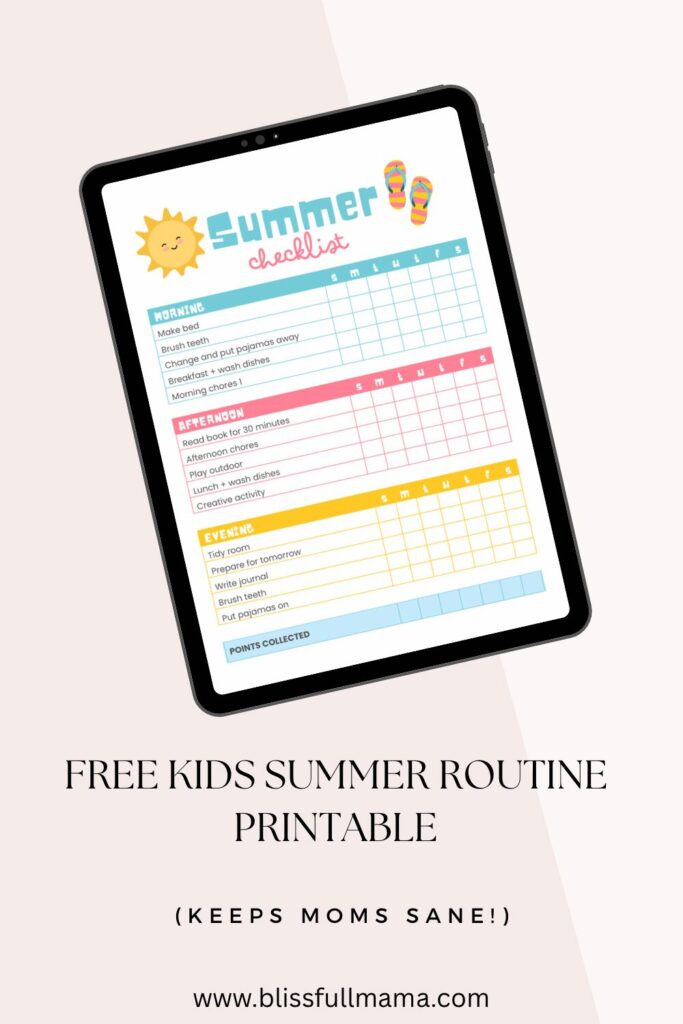
AD Kids morning routine checklist chart
8:00 AM – 9:30 AM: Move Your Body Time (Non-Negotiable)
Goals: Physical output BEFORE anything sedentary
This is the single most important time block of the day. I cannot stress this enough.
Boys who move in the morning are calmer, more focused, and easier to be around for the rest of the day. Boys who sit and watch TV first thing are harder to manage, more irritable, and more likely to fight with each other by noon.
This is not optional in our house. It’s the anchor of the entire summer routine.
What this looks like:
- Backyard time: bikes, scooters, basketball, soccer, water hose on hot days
- Obstacle course: cones, hula hoops, jump rope stations
- Walk or bike ride around the neighborhood
- Trampoline if you have one — 30 minutes does more than you’d think
- Rainy days: indoor dance party, hallway bowling with water bottles, pillow obstacle course
The 90-minute block feels long, but for boys this age it flies by. Let them be wild. That’s the whole point.
AD Outdoor sports set for boys
AD Adjustable kids scooter ages 3-8
AD Backyard water play set
For 50 specific outdoor ideas, check out [50 Outdoor Games for Boys That Burn Energy Fast This Summer].
9:30 AM – 10:30 AM: Learning Hour
Goals: Keep minds engaged, prevent the summer brain drain
This does not need to feel like school. The goal is 45-60 minutes of intentional brain activity that isn’t screens.
By age:
- Ages 2-3: Shape sorters, stacking, simple puzzles, naming colors and objects
- Ages 4-5: Tracing letters, counting games, simple crafts, reading aloud together
- Ages 6-7: Summer bridge workbooks, reading independently, simple math games
- Ages 8-9: Independent reading, journaling, logic puzzles, STEM activity kits
I keep this time low-key. My older two work at the kitchen table while I sit nearby with the little ones. Nobody is lecturing. It’s just quiet, focused activity for an hour.
AD Summer bridge workbook grades K-1
AD Summer bridge workbook grades 2-3
AD STEM activity kit ages 6-9
AD Logic puzzle book for boys ages 7-10
10:30 AM – 12:00 PM: Free Choice Time
Goals: Independence, creativity, self-directed play
This is where the activity bins come in. Free choice means exactly that — they choose from the bins, from the backyard, from the craft supplies. You are not the cruise director for this block.
The only rule: screens are not a free choice option right now. That comes later.
What usually happens in our house:
- My 9 and 7-year-old build elaborate Lego or cardboard cities together
- My 4-year-old draws, does sticker books, or plays with playdough
- My 2-year-old plays independently nearby or naps early
Some days they play together. Some days they each do their own thing. Both are fine. The goal is self-directed, unstructured play — something boys don’t get nearly enough of during the school year.
On days they’re fighting constantly, check out [How to Keep Brothers From Fighting All Summer Long].
AD Creative building set for mixed ages
AD Giant Lego storage and building table
12:00 PM – 1:00 PM: Lunch and Kitchen Helper Time
Goals: Refuel, teach life skills, connect
Lunch is not just a meal in our house — it’s a teaching moment. Every day, one of the boys has a job. The 9-year-old makes sandwiches. The 7-year-old sets the table. The 4-year-old rinses fruit. The 2-year-old hands me things and feels important.
Boys who learn to do real things in the kitchen carry that confidence forever.
Easy summer lunches they can help make:
- Build-your-own sandwiches or wraps
- Smoothies they pour into their own cups
- Quesadillas they flip themselves (older boys)
- Fruit and veggie plates they help assemble
Cleanup is part of the deal. Everyone brings their plate to the sink. The older boys wipe the table. Not optional, not a fight — just how lunch ends.
AD Kids safe cutting knives set
AD Color-coded plates by child
1:00 PM – 2:30 PM: Quiet Time — The Sacred Block
Goals: Rest, reset, independent activity, MOM TIME
This is the most important block of the day for YOU.
The 2-year-old naps. The 4-year-old goes to his room for rest — whether he sleeps or not, he stays in his space. The older two have quiet time in their rooms: reading, Legos, drawing, audiobooks with headphones.
No exceptions. No negotiations. This block happens every single day, even on days they say they’re not tired. You don’t have to sleep. You do have to be quiet in your space.
It took about a week of consistent enforcement before my boys stopped fighting this. Now they don’t even question it. It’s just what happens after lunch.
What you do with this block is entirely up to you. Blog. Nap. Shower. Read. Sit in silence and stare at the wall. Whatever recharges you.
AD Volume-limiting kids headphones for audiobooks
AD Quiet time activity box for toddlers
AD Glow-in-the-dark stars for bedroom ceiling
2:30 PM – 4:00 PM: Screen Time Window
Goals: Intentional, bounded screen time — not default mode
I am not anti-screen. Screens are not the enemy. The problem is screens without limits — the all-day default that creeps in when there’s no structure.
This is the only scheduled screen time window in the day, and it works because it’s predictable. The boys know it’s coming. They don’t feel deprived. They don’t spend the whole morning begging for the iPad because they know they’ll get it at 2:30.
The timer goes on when screens go on. When the timer ends, screens off. The timer becomes the bad guy, not you — which is a beautiful thing.
AD Kids Fire tablet with parental controls
AD Blue light blocking glasses for kids
4:00 PM – 5:30 PM: Second Wind Outdoor Time
Goals: Second physical output, burn energy before dinner
Late afternoon is when boys get their second wind. If you keep them inside, they climb the walls. Push them back outside and they burn through it — and come to the dinner table noticeably calmer.
This block is looser than the morning. No structured activity needed. Just get outside. Bikes, basketball, neighbor friends, sprinklers, whatever.
On days going outside isn’t possible, swap in active indoor alternatives from [20 Indoor Activities for Boys to Beat Summer Boredom].
AD Backyard water table for toddlers and preschoolers
AD Adjustable outdoor basketball hoop
5:30 PM – 7:00 PM: Dinner and Family Wind-Down
Goals: Connect, decompress, transition to evening
Dinner in our house is simple. Everyone at the table. No phones — including mine. We do a quick high-low: one good thing from the day, one hard thing. Even the 2-year-old participates, kind of.
After dinner is slow time. A walk if it’s still nice outside. A board game. Reading together. Low stimulation, intentional connection.
This is not the time for more roughhousing or screens. The goal is to start bringing their systems down so bedtime isn’t a nightmare.
AD Family card game for all ages
AD Read-aloud chapter book collection for boys ages 4-10
7:00 PM – 8:00 PM: Bath and Bedtime Routine
Goals: Wind down, clean up, sleep
Bath time in a house full of boys is its own event. We do it in stages — little ones first, older boys after. For a complete bath time routine that works without the meltdowns, read [How to Make Bath Time a Fun and Relaxing Routine for Kids].
After baths:
- PJs on, teeth brushed (verify this — my boys are very optimistic about this step)
- One book or audiobook per child
- Quick gratitude: name one thing you’re grateful for today
- Lights out
The 2 and 4-year-olds are asleep by 7:30. The older boys read independently until 8:00 or 8:30.
AD Lavender bubble bath for kids wind-down
AD Sound machine for kids rooms
AD Blackout curtains for bright summer evenings
How to Handle the Hard Days
When Brothers Won’t Stop Fighting
Almost always the fix is one of three things: they need physical output, they need separation, or they need individual attention.
If it’s before 9:30 AM and they haven’t moved yet, take them outside immediately. Don’t try to resolve the conflict first. Movement resets their nervous systems faster than anything.
If it’s mid-afternoon and they’ve been together for hours, separate them. Different rooms, different activities. Thirty minutes of solo time is usually all they need.
For a full strategy guide, check out [How to Keep Brothers From Fighting All Summer Long].
When They’re Genuinely Bored
Good. Let them be bored for 10 minutes. Boredom is the engine of creativity. If you jump in immediately with a solution, you rob them of the chance to figure it out.
If after 10-15 minutes they’re still stuck, point to the bins. Not the TV. Not the iPad. The bins.
When You’re Running Errands or Traveling
Protect the two most important anchors: morning movement and quiet time. Even a 20-minute walk before you leave the house counts. Even 45 minutes of headphones-and-audiobook in the car counts as quiet time. Protect those two things and the rest of the day is manageable.
When You’re Exhausted and Just Can’t
It happens. One off day doesn’t break a routine. What breaks a routine is letting one off day become a week off.
Give yourself grace on the hard days. Show up again the next morning. The routine is patient.
If you’re running on empty consistently, read [How to Recover from Mom Burnout and Actually Feel Like Yourself Again].
Weekly Themes to Keep the Routine Feeling Fresh
One reason summer routines fall apart is boredom — not the kids’ boredom, but yours. Weekly themes solve this without blowing up the structure. The time blocks stay the same. Only the activity focus changes.
- Week 1: Water Week — every outdoor block involves water play
- Week 2: Building Week — free choice time centers around Legos, cardboard, construction
- Week 3: Science Week — learning hour does simple experiments every day
- Week 4: Sports Week — morning movement is a different sport each day
- Week 5: Nature Week — scavenger hunts, bug journals, outdoor exploration
- Week 6: Art Week — creative time gets extra supplies and a gallery wall at the end
Just pick a theme on Sunday night for the week ahead. The boys look forward to knowing what’s coming.
For summer bucket list ideas that work perfectly with these themes, check out [Summer Bucket List for Boys: 50 Fun Ideas Ages 2-9].
Summer Routine by Age: What This Looks Like at Each Stage
Ages 2-3: Toddlers in the Routine
Toddlers can’t follow the full schedule, but they benefit from the rhythm. Consistent nap and meal times, physical play every morning, and a clear bedtime routine is the whole job at this age. Your toddler will shadow you and the older kids. Let him participate in what he can.
Ages 4-5: Preschoolers Stepping Up
Four and five-year-olds can follow a visual schedule independently. This is the age to introduce the routine chart on the wall. They love checking off boxes and feeling capable. Give them one real job in each block — small jobs with real results build big confidence.
Ages 6-7: Building Real Independence
This age can handle full independent blocks. Your 6-7-year-old can do morning movement without constant supervision, complete learning hour workbooks independently, and manage quiet time on his own. Let him set his own alarm. Give him leadership roles with the younger kids.
Ages 8-9: Running Their Own Program
At this age your son should be largely self-managing within the structure. He knows the blocks. He knows the expectations. Your job shifts from directing to overseeing.
Give him a weekly challenge: read 2 books, practice one skill for 20 minutes daily, teach his younger brother one new thing. Nine-year-olds thrive with missions.
AD Bestselling chapter book series for boys ages 8-12
AD Kids journal with daily prompts
What to Have Stocked for a Smooth Summer
These are the things that actually make this routine run without friction. You can find all of these in my storefront at https://a.co/d/0cvGZGPM.
For Morning Movement
AD Outdoor sports set — cones, balls, goals, covers all ages
AD Sidewalk chalk bulk pack
AD Water balloons that fill fast
For Learning Hour
AD Summer workbook pack — multiple grades
AD STEM experiment kit for curious boys
AD Drawing how-to books for boys
For Quiet Time
AD Noise-limiting kids headphones
AD Magnetic tiles building set
AD Glow-in-the-dark stars for bedroom ceiling
For Bath and Bedtime
AD Kids lavender bubble bath
AD White noise machine for kids rooms
AD Blackout curtains for bright summer evenings
Frequently Asked Questions
What time should a summer routine start for boys?
There’s no perfect time — it depends on your family’s natural wake-up. What matters more than the start time is the sequence: physical activity first, screens last. Whether your day starts at 7:00 AM or 8:30 AM, structure it so boys move their bodies before anything sedentary. That single shift changes the entire day.
How do I get my boys to actually follow the routine?
Visual cues beat verbal reminders every time. Post the schedule where they can see it. Use a timer so transitions aren’t you nagging — the timer signals the change. Involve them in creating the schedule so they feel ownership. Expect about one to two weeks of resistance before it becomes automatic. Be consistent during that window and it clicks.
How much screen time is appropriate in summer for boys ages 4-9?
Pediatricians generally recommend 1-2 hours of intentional screen time per day for this age range. What matters most is when screens happen and what’s on them. In this routine, screens are one defined 90-minute window in the afternoon — structured, expected, and followed by movement. That framework works better than strict minute-counting.
What do I do when my boys fight constantly during summer?
Almost always, constant fighting comes down to three things: not enough physical output, too much shared time without a break, or a need for individual attention. Address movement first. If they’ve already moved and are still fighting, separate them into different spaces for 30-60 minutes. For specific strategies, read [How to Keep Brothers From Fighting All Summer Long].
How do I keep the routine going when we travel or have a busy week?
Protect the two anchors: morning movement and afternoon quiet time. Everything else can flex. A routine that survives disruption is a routine that sticks.
Final Thoughts from a Mom of 4 Boys
Summer with multiple boys doesn’t have to be survival mode.
I know that’s easy to say when you’re in the thick of it. But one week of consistent structure genuinely changes the entire summer. The boys calm down. The fighting decreases. The days start feeling manageable instead of endless.
You don’t need a perfect routine. You need a consistent rhythm with physical activity anchoring the morning and quiet time protecting the afternoon. Everything else builds around those two things.
Start Monday. Pick one block to nail first. When that one feels solid, add the next.
You’ve got this.
What to Read Next
- [50 Outdoor Games for Boys That Burn Energy Fast This Summer]
- [20 Indoor Activities for Boys to Beat Summer Boredom (Ages 2-9)]
- [How to Keep Brothers From Fighting All Summer Long]
- [Chores for Boys by Age: 60+ Age-Appropriate Chores for Kids Ages 2-9]
- [Summer Bucket List for Boys: 50 Fun Ideas Ages 2-9]
- [How to Make Bath Time a Fun and Relaxing Routine for Kids]
📋 Free Printable: The Summer Routine Chart for Kids
Need this schedule in a pretty, fridge-friendly format?
🎉 Grab your free download here:
👉 Summer Routine Printable (PDF)
4 Comments