
Summer Planner for Kids (How We Finally Got Our Days Under Control)
As an Amazon Associate, I earn a small commission from qualifying purchases.
Summer without a plan lasts about three days before everything falls apart.
I know because I lived it. Four boys home all day, no structure, no rhythm, and by day four I was negotiating screen time at 8am just to get through breakfast in peace.
What finally changed things wasn’t a strict schedule or a perfect routine.
It was a summer planner for kids, something visual, flexible, and simple enough that my boys could actually follow it without me directing every single move.
This post walks through how we use a summer planner in our house, what to include in one, and the free printable you can grab right now
and put on the fridge today.
Why a Summer Planner for Kids Changes Everything
The problem with unstructured summer days isn’t that kids are bad at entertaining themselves. It’s that they don’t know what’s coming next.
When kids have no idea what the day holds, they default to the most stimulating option available, usually screens. And once screens become
the default, getting them off becomes a battle every single time.
A summer planner solves this before it starts. When kids can see the day’s shape, morning activities, outdoor time, quiet time, free time, screen time, they stop asking constantly and start moving through the day with less resistance.
It’s not about controlling every minute. It’s about giving the day enough structure that kids feel secure and you feel sane.
For more on building a full summer routine around the planner, check out my Ultimate Summer Routine for Kids it maps out exactly what each block of the day looks like in our house.
What to Include in a Summer Planner for Kids
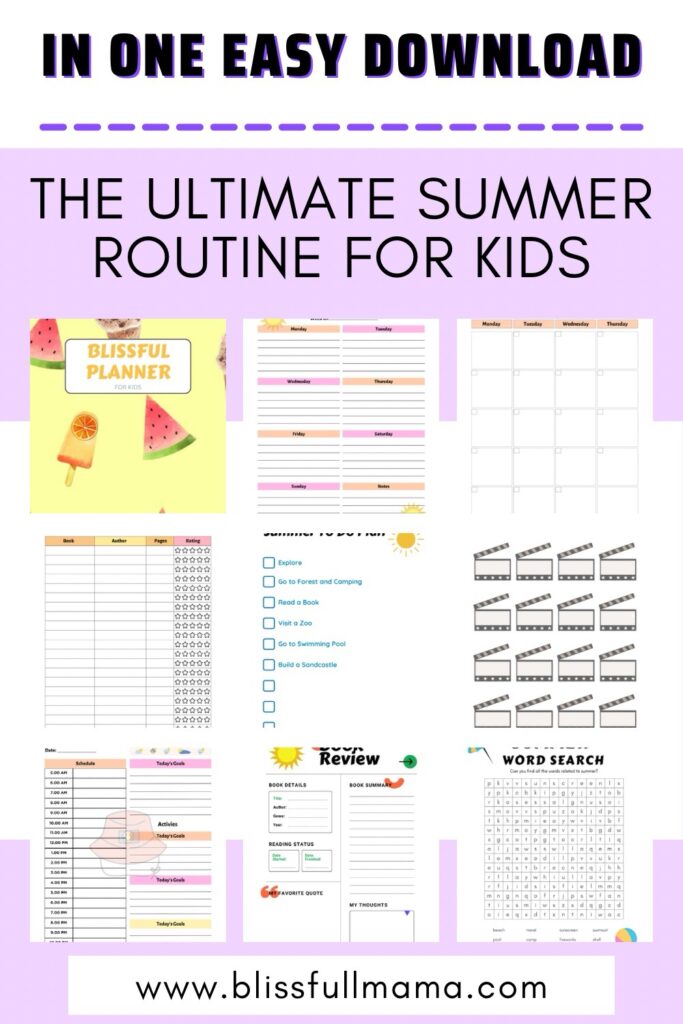
A good summer planner for kids covers five things:
1. Daily schedule or time blocks
Not minute-by-minute, just a loose framework for the day.
Morning activities, outdoor time, lunch, quiet time, free play, screen time window, dinner, bedtime. Seven anchors is all you need.
2. A daily checklist
Simple habits kids track themselves, brushed teeth, read for 20 minutes, played outside, helped with one chore, practiced something.
Kids love checking things off and it builds independence fast.
3. A summer bucket list
Things they want to do before school starts. Let them help make this list.
Having goals they chose themselves keeps kids motivated and gives you easy go-to activities when boredom hits. For ideas, check out my Summer Bucket List for Boys 50 ideas that actually work for ages 2-9.
4. A reading tracker
One of the easiest ways to keep learning going over summer without it feeling like school. A simple list of books they want to read or a challenge chart where they color in each book they finish works
brilliantly for ages 5 and up.
5. A weekly family plan
Playdates, trips, movie nights, activities, mapped out at the start of each week so kids stop asking “what are we doing today” every morning.
Even two planned activities a week gives the whole week a different feel.
How We Use Our Summer Planner With 4 Boys
In our house, Sunday evening is planner time.
I sit down with the boys and we fill in the weekly plan together, any outings, any activities, any movie nights. They each add something to the bucket list if they think of something new.
Then every morning we look at the daily checklist together.
My older boys (9 and 7) follow it mostly independently.
My 4-year-old needs more prompting but knowing what’s on the list means I’m reminding, not fighting.
The biggest shift for us was having screen time as a scheduled block in the afternoon, not a reward, not a punishment negotiation, just a part of the day. “It’s not screen time yet, we do that after quiet time.”
That one sentence ended about 80% of our screen time battles.
What You Need to Set Up Your Summer Planner
You don’t need much, just a few supplies to make it work smoothly:
A good binder or clipboard for printing pages:
(AD) This clear clipboard
is perfect for displaying the daily schedule on the counter.
Colored markers or crayons for the kids:
Let them personalize their pages and track their own checklists.
(AD) This washable marker set
works perfectly for the reading tracker and bucket list pages.
A whiteboard for the weekly family plan:
(AD) This magnetic fridge whiteboard
is what we use for the weekly overview so everyone can see it at a glance.
A visual timer for time blocks :
(AD) This time timer
makes transitions between blocks so much smoother, kids can see exactly how long until screen time or outdoor time ends.
A dedicated planner storage spot:
A simple magazine file or folder on the counter keeps all the pages
organized and accessible. When everything has a home, kids can find
their own pages without asking you every time.
Grab the Free Summer Daily Checklist
Not ready for the full planner yet? Start with the free printable, the Summer Daily Checklist for Kids.
It’s a simple, visual checklist your kids can follow independently every morning. Print it, laminate it if you want to reuse it, and tape it somewhere they can see it.
It covers the daily basics, morning routine, outdoor time, reading, helping around the house, and creative activity, in a format kids ages 4 and up can actually follow on their own.
👉 Grab the free summer daily checklist here
Get the Full 50-Page Summer Kids Planner
The full planner has everything, daily pages, weekly planning sheets, a summer rules page, reading tracker, movie list, journaling pages, and a full summer bucket list template.
It’s undated so you can start it any time, use the pages you need, and come back to it all summer long. Available as an instant digital download so you can print and start today.
👉 Get the full Summer Kids Planner here
5 Ways to Get the Most Out of Your Summer Planner
- Print only what you need each week, no need to print all 50 pages at once
- Fill in the weekly plan together on Sunday evenings, kids who help plan are more likely to follow the plan
- Laminate the daily checklist so kids can check off with a dry-erase marker and reuse it daily
- Post the summer rules page on the fridge at the start of the season and refer back to it instead of repeating yourself
- Use the journaling pages at bedtime as a 5-minute wind-down ritual, it ends the day on a reflective, calm note
Summer Planner for Kids: Frequently Asked Questions
What should a summer planner for kids include?
A good summer planner for kids should include a daily checklist of simple habits and activities, a loose time-block schedule for the day, a summer bucket list kids helped create, a reading tracker,
and a weekly family plan. The most important thing is keeping it visual and simple, kids need to be able to follow it independently,
not just understand it when a parent explains it.
What age is a summer planner for kids appropriate for?
Most kids ages 4 and up can benefit from a summer planner in some form.
Younger kids (4-6) do best with a simple picture-based daily checklist.
Kids ages 7 and up can use more detailed daily pages, reading trackers,
and even help fill in the weekly family plan themselves.
Having kids involved in filling out their own planner increases
how much they actually follow it.
How do I get my kids to actually use the planner?
The two things that make the biggest difference are ownership and
visibility. Let kids personalize their pages — add stickers, color
the headers, choose what goes on the bucket list. Then post it
somewhere visible at their eye level. A planner in a drawer gets ignored.
A planner on the fridge gets checked. Keep it accessible and the routine
of checking it builds naturally within about a week.
Is a summer planner better printed or digital?
For kids, printed is almost always better. A physical checklist
they can mark off with a pencil or dry-erase marker is more engaging
than a screen-based list and doesn’t require any device access.
Printing a week at a time keeps it fresh and manageable.
How do I keep a summer routine without it feeling too strict?
The key is structure within flexibility — fixed anchor points like
morning checklist, outdoor time, quiet time, and screen time window,
but freedom within each block. Kids know when each part of the day
happens but they choose what they do within it. That balance gives
parents the predictability they need and kids the autonomy they want.
Final Thoughts from One Mom to Another
You don’t need a perfect summer. You don’t need to plan every second or create a magical Pinterest camp at home. You just need a few tools to help you bring intention to the madness.
This planner helped me do that, and I truly believe it can help you too.
It’s flexible, simple, and actually doable for real-life moms with real-life kids (and messy living rooms).
So if you’re ready for a smoother, more joyful summer with your little ones, grab the planner today and take that first step toward calm.
👉 Click here to get your copy now
You’ve got this. And I’m cheering you on 💛
P.S. Already using the planner? I’d LOVE if you pinned it or shared with another mama who needs a little more peace this summer.