
How to Stop Feeling Behind on Housework as a Busy Mom
Learning how to stop feeling behind on housework as a busy mom starts with a question I’ve had to ask myself: What am I expecting my house to look like while six people are living in it?
I’m a mom of four boys, and clutter is one of the things that makes our home feel overwhelming the fastest. Toys, clothes, school things, books—each item might be small, but when they’re spread across every room, it feels like the whole house needs my attention.
And I already have plenty that needs my attention.
There are meals to make, children to help, routines to keep moving, and things I want to do for myself. I can be busy all day and still look around in the evening thinking, How is there this much left to do?
If that sounds familiar, I understand.
Short daily resets have helped me. So has getting clearer about what actually needs doing today. I still have a busy family home, but I’m learning to stop treating every unfinished task as evidence that I should have done more.
Here’s a practical place to start if you’re tired of feeling like you can never catch up.
This post contains affiliate links. As an Amazon Associate, I earn from qualifying purchases.
Why You Feel Behind Even When You’ve Been Busy All Day
Think about how much work disappears as soon as you do it.
You prepare breakfast, and everyone eats it. You wash school clothes, and the kids wear them. You clear a space for the children to play, and they use it.
By evening, there may be very little visible evidence of all that effort.
Meanwhile, the things you haven’t done are sitting right in front of you. The laundry basket. The kitchen counter. The toys waiting to go back in their bins.
It’s easy to measure your day by those unfinished jobs and forget everything you already handled.
Before you decide you’re behind, take a moment to count the work you did. Feeding your family, helping with homework, managing appointments, and caring for a toddler all take time. That time belongs in the picture when you’re deciding what you could reasonably have accomplished.
It also helps to separate housework into three groups:
| Type of housework | Examples | How to approach it |
| Everyday upkeep | Dishes, food messes, putting away essentials | Give it a small, regular place in the day |
| Regular cleaning | Bathrooms, floors, bedding | Spread it across a schedule that fits your household |
| Bigger projects | Sorting toys, clearing closets, organizing paperwork | Choose one small project when you have capacity |
When you’re overwhelmed, all three can feel equally urgent. Writing them down separately makes it easier to see what needs your attention first.
Too Much to Do? Choose Your Next Small Step.
Get the free Done Enough Housework Reset to choose your three daily priorities, follow a simple 10-minute reset, and decide what can wait.
Print it once or use a fresh page whenever housework starts to feel overwhelming.
1. Give “Caught Up” a Realistic Definition
What would it take for you to feel caught up on housework?
If your answer includes every room being clean at once, an empty laundry basket, and all the toys put away, you may be waiting for a very brief moment.
With young children at home, the house changes throughout the day. Your standard needs to leave room for that.
Try completing this sentence:
“For today, our home is manageable when…”
Then choose three things that would make the biggest difference. For example:
- We have enough clean dishes and counter space to prepare the next meal.
- We can walk through the main living area comfortably.
- The clothes and school things we need tomorrow are ready.
Those priorities give you somewhere to stop on a demanding day.
You can still clean the bathroom or tackle a drawer when you have time. But you’ll know which jobs deserve your limited energy first.
And if your family is going through illness, disrupted sleep, or an especially busy week, adjust the list. A routine should make your current life easier.
2. Choose One Clutter Hot Spot to Make Easier
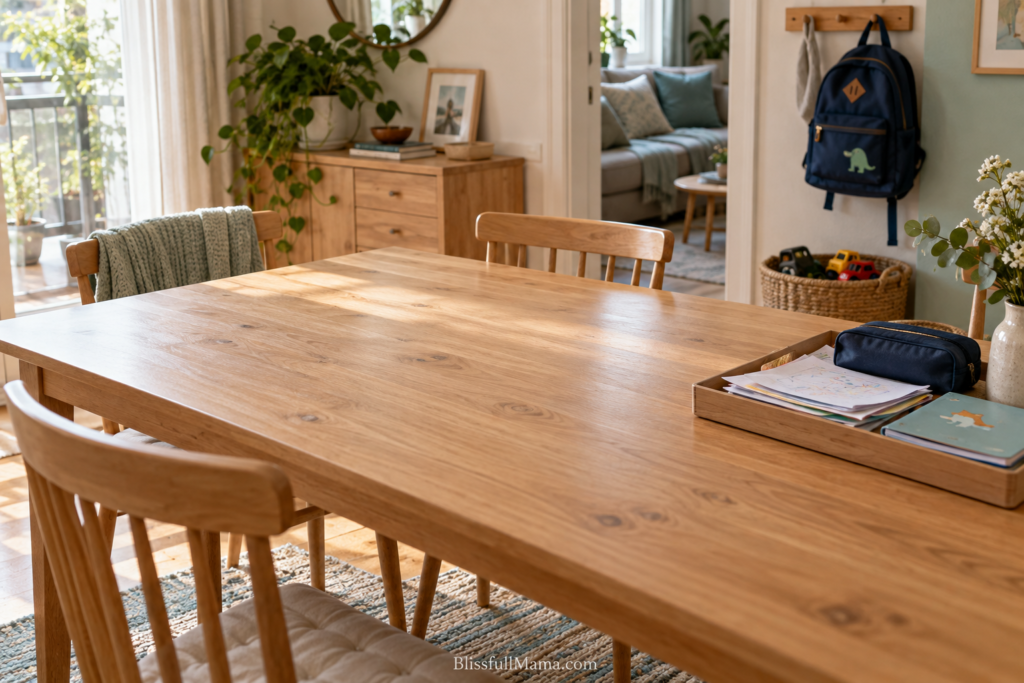
When clutter is everywhere, deciding where to begin can take as much energy as tidying.
Start with the spot that interrupts your day most often.
Maybe you move piles off the table before every meal. Maybe you search for shoes each morning. Maybe the couch is covered in things that need to go upstairs.
Pick one of those places and ask:
“What keeps landing here, and where could it go with the least effort?”
Keep the solution simple:
- Put a shoe basket where shoes are usually taken off.
- Give incoming school papers one tray.
- Keep a small book basket beside the usual reading spot.
- Place an easy-to-reach toy bin near the area where the children play.
Try a basket or container you already own before buying anything.
Then look at whether putting things away requires too many steps. If your child has to move three boxes, open a stiff lid, and squeeze a toy into an overflowing bin, cleanup is going to need a lot of help.
The easier the storage is to use, the easier it is to practice putting things back.
You can browse home organization ideas in my (AD) Amazon storefront if you need a particular storage solution. Measure your space and decide what you’re storing before ordering.
3. Use a 10-Minute Reset With a Clear Finish
Short resets help me because they give housework a limit. I can make a useful difference without committing the whole afternoon.
Choose one busy space and set a timer for 10 minutes:
- Pick up obvious trash.
- Take cups and dishes to the kitchen.
- Return the easiest items to their homes.
- Clear one surface you need to use.
- If time remains, deal with visible crumbs or dirt in that area.
Stay in that space as much as possible. If something belongs elsewhere, collect it in a basket and return it at the end.
When the timer ends, stop and notice what you finished. Handle anything that needs immediate attention, then let the rest wait for its planned time.
For a more detailed version, follow my 10-minute-a-day cleaning routine for moms.
4. Attach the Reset to Something That Already Happens
A routine is easier to remember when it has a familiar place in your day.
You could try:
- Clearing the table after breakfast
- Putting school things away after the afternoon snack
- Returning toys before the bedtime routine
- Resetting the kitchen after dinner
Choose one of these to begin with. Give it a few days before deciding whether to add another.
Include the children in a specific, manageable way: “Put the cars in this bin” or “Take your shoes to the basket.” They may still need reminders and help, but the task has a clear finish.
If evenings are the best fit for your family, my nightly reset routine for busy moms walks through the jobs that help prepare the house for the next morning.
For today, keep your starting point small: choose your three priorities, clear one useful space, and decide when you’ll return to it tomorrow.
You’re allowed to make progress in a home that still looks lived in.
5. Work Through the Backlog One Small Job at a Time
Daily resets help with the things your family uses every day. But what about the laundry that has been waiting all week, the overflowing toy bins, or the pile of papers you keep moving around?
Those jobs need a place in your plan, too.
Write down the tasks that keep coming to mind. Then choose one small piece of one task to work on after your daily essentials.
Make the job specific enough that you can tell when it’s finished:
- Put away one basket of clean clothes.
- Sort the papers on the kitchen counter.
- Remove the outgrown clothes from one drawer.
- Check one toy bin for broken pieces and things your children no longer use.
“Organize the house” has no useful stopping point. “Clear this drawer” does.
If you have 10 minutes, choose a job you can leave in a better state after 10 minutes. Emptying an entire closet onto the bed probably won’t help on a day when you’re already stretched.
And when you miss a day, return to the next small job. You can continue without restarting the whole plan.
For a weekly opportunity to check what needs attention, use my Sunday reset routine for busy moms. Choose the sections that fit the time you have.
6. Give Everyone a Clear Part of the Housework
With four boys at different ages, the amount of help each child can give looks different. My older boys can help fold and put away clothes. My younger children need smaller jobs and more support.
That still gives us a starting point.
“Clean up” can feel enormous to a child. Try a direction they can picture:
- “Put these books in the basket.”
- “Take your shoes to their spot.”
- “Put your folded shirts in this drawer.”
- “Collect the cars from the rug.”
Do the first few items together if they need help getting started. Keep expectations appropriate for their age and ability.
If you share your home with another adult, talk about who owns a recurring task from beginning to end. For example, being responsible for school bags could include checking them, dealing with papers, and preparing what’s needed tomorrow.
It helps to agree on what finished looks like and when it needs to happen. Otherwise, you may still be carrying all the checking and reminding.
Sharing the work takes practice. Choose one responsibility to make clearer this week.
7. Look at What Keeps Coming Back
If you’re picking up the same things several times a day, pause before adding another cleanup session.
Look at the cause.
An overflowing toy bin may need fewer toys in it. Clothes on the bedroom floor may need a hamper closer to where everyone gets changed. A pile of school papers may need a regular time for decisions.
Ask yourself:
- Does this item have a home?
- Can the person using it reach that home easily?
- Is there enough space to put it away?
- Are we keeping things we no longer use?
In a small home, even useful things can become difficult to manage when too many are out at once. You might try storing a small selection of toys away and swapping them later, or keeping everyday items separate from things you use occasionally.
For children’s belongings, involve them in decisions where appropriate. Begin with obvious rubbish, broken items you won’t repair, and things you already know your family has finished using.
Reducing a recurring pile can save you from sorting that same pile again tomorrow.
8. Make Laundry Easier to Finish
Laundry can feel permanently unfinished in a family home. There will usually be something in a hamper, especially with children.
In our family of six, I generally do two loads a day on four days of the week, and the boys help fold and put their clothes away. Your household may need a completely different rhythm.
The useful question is: Where does laundry get stuck?
If washed clothes sit in baskets for days, adding more washing may create a bigger pile. Give folding and putting away a place in the routine, even if it’s only one basket at a time.
You can also simplify the parts that don’t matter much to you. Pajamas and everyday play clothes may be fine loosely folded or placed in an easy-to-use drawer.
Start with what your family needs next: underwear, school clothes, work clothes, and towels. That makes the next day easier while you gradually work through the rest.
9. Choose Tools That Help With a Specific Job
A useful cleaning tool can make a frequent task easier. Before buying one, decide which problem you want it to solve.
For quick crumbs and small floor messes, a cordless vacuum such as the Dyson V8 is one option to compare. Its cordless design may suit short cleanups when getting out your usual vacuum feels cumbersome. Check the exact model’s floor head, weight, and charging requirements.
(AD) Shop Dyson V8 options on Amazon
If you prefer an upright vacuum for regular floor cleaning, the Shark Navigator Lift-Away offers upright and portable Lift-Away configurations. Consider where you’ll store it and whether that format suits your home.
(AD) Shop Shark Navigator NV352 on Amazon
Both are optional purchases to consider if your current vacuum needs replacing. Use the tools you already own when they’re doing the job well.
You can also browse my (AD) Amazon storefront for more home and family finds.
10. Decide When You’re Finished for Today
There is almost always another household job you could do.
That makes a stopping point helpful, especially when you’re tired and every unfinished task starts to feel urgent.
Choose a boundary that fits the day:
- “After the kitchen reset, I’m finished for tonight.”
- “I’ll put away this basket, then sit down.”
- “I’ll spend 10 minutes clearing the table and leave the cupboard for another day.”
If something keeps nagging at you, write down the next step and when you might do it. You don’t have to keep rehearsing it in your head.
You’re allowed to have time for a shower, a book, your own work, or simply sitting with your family while ordinary chores remain unfinished.
What to Do When You Feel Behind on Everything
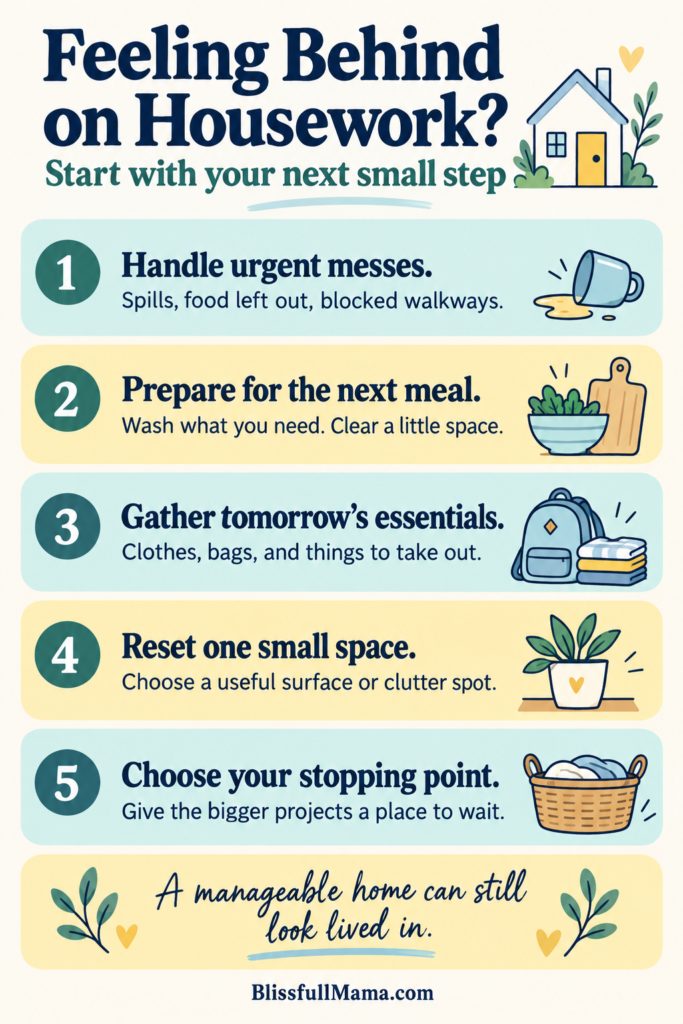
On a particularly difficult day, use this short plan:
- Handle anything unsafe or likely to get worse, such as spills, food left out, or a blocked walkway.
- Prepare for the next meal by washing the dishes you need and clearing a little working space.
- Gather tomorrow’s essentials, including clothes, bags, and anything you must take out.
- Reset one small area if you still have energy.
- Leave the bigger projects on your list.
The next day, return to your usual routine. Add one backlog task when you have the capacity.
A More Manageable Home Starts With Today’s Next Step
If you’ve been wondering how to stop feeling behind on housework as a busy mom, begin with a standard you can actually reach.
Choose what matters most today. Make one space easier to use. Give the people in your home a clear way to contribute. Then let yourself notice the work you finished.
I still find clutter overwhelming at times. Raising four boys means our home has plenty happening in it, and I’m still learning what works for us.
But a short reset gives me somewhere to begin—and somewhere to stop.
Tonight, choose one thing that will help tomorrow feel easier. Clear the table, put away the school things, or deal with one laundry basket.
That is useful progress. Let it count.
Before you go, grab the free Done Enough Housework Reset. Use it to choose what matters today and give yourself a clear place to stop.
Which part of housework makes you feel most behind: clutter, dishes, or laundry? Share it in the comments.